Planning
Plan on your anatomy
Implant size and position are decided on a 3D model of your own knee or hip, not an average one.
3D model of your joint
22+ years and thousands of joint replacements. First centre in Jalandhar to introduce computer-navigated joint replacement, and the 6th centre in India to introduce robotic joint replacement.
Send your X-ray or MRI on WhatsApp before you come.
The robot does not operate. It builds a 3D plan from your CT, holds the surgeon inside that plan to sub-millimetre accuracy, and verifies alignment and ligament balance before a single cut is finalised.
Implant size and position are decided on a 3D model of your own knee or hip, not an average one.
Bone cuts stay inside the planned boundary, which protects surrounding ligament and muscle.
Most patients stand and walk with support the same or next day, on a monitored physiotherapy plan.
Balance and alignment are recorded intra-operatively — accuracy is verified, not estimated.
These are photographs from our own robotic joint replacement programme. NHS Ortho Robotics is a unit of NHS Hospital, Jalandhar, and runs a dedicated robotic joint replacement programme with a team of five orthopaedic surgeons.
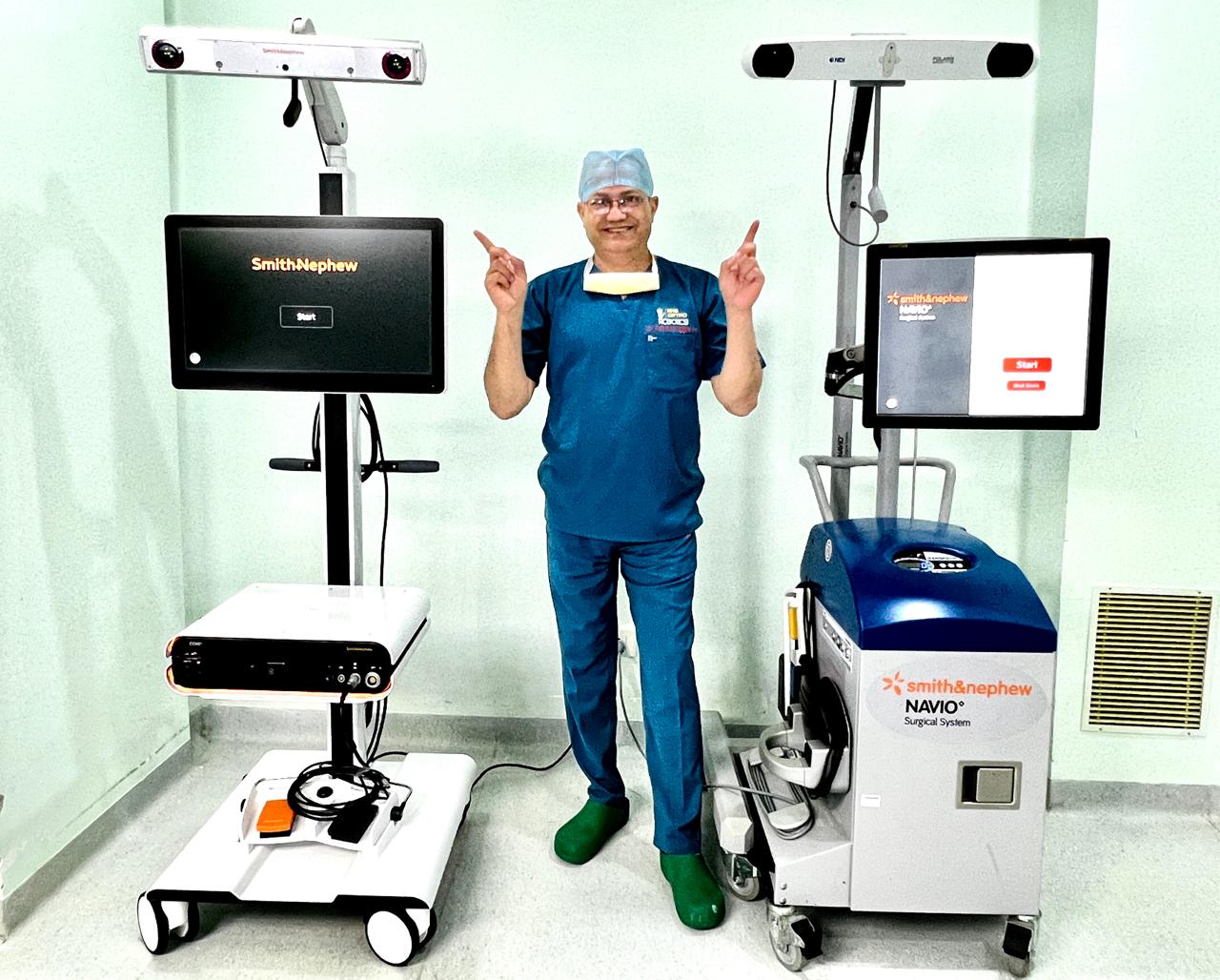
The twin-screen robotics cart used for knee arthroplasty, with a member of the surgical team alongside it.
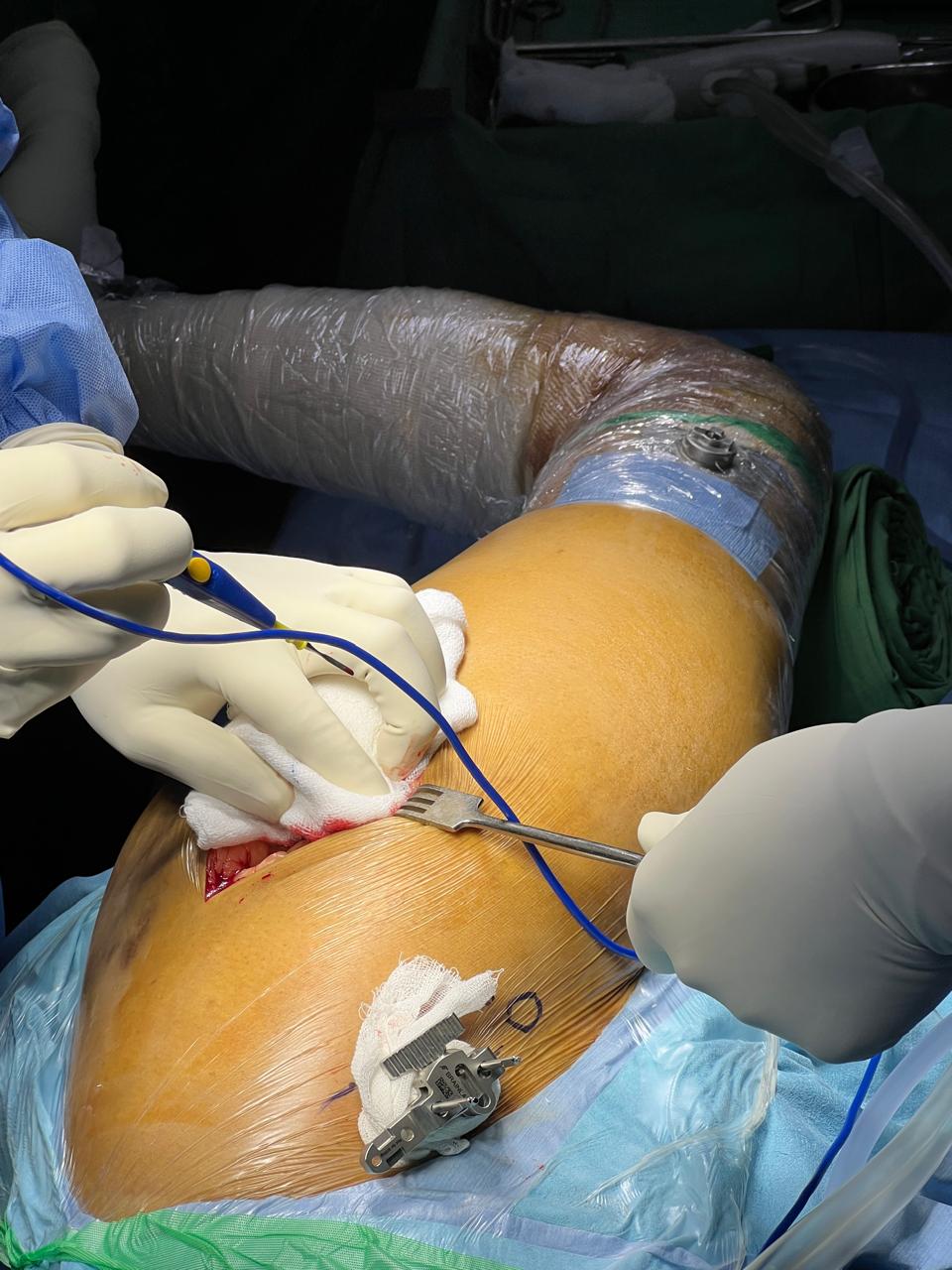
Tracker arrays fixed to the femur and tibia let the system map your knee in real time, so every cut is checked against the plan as it happens.
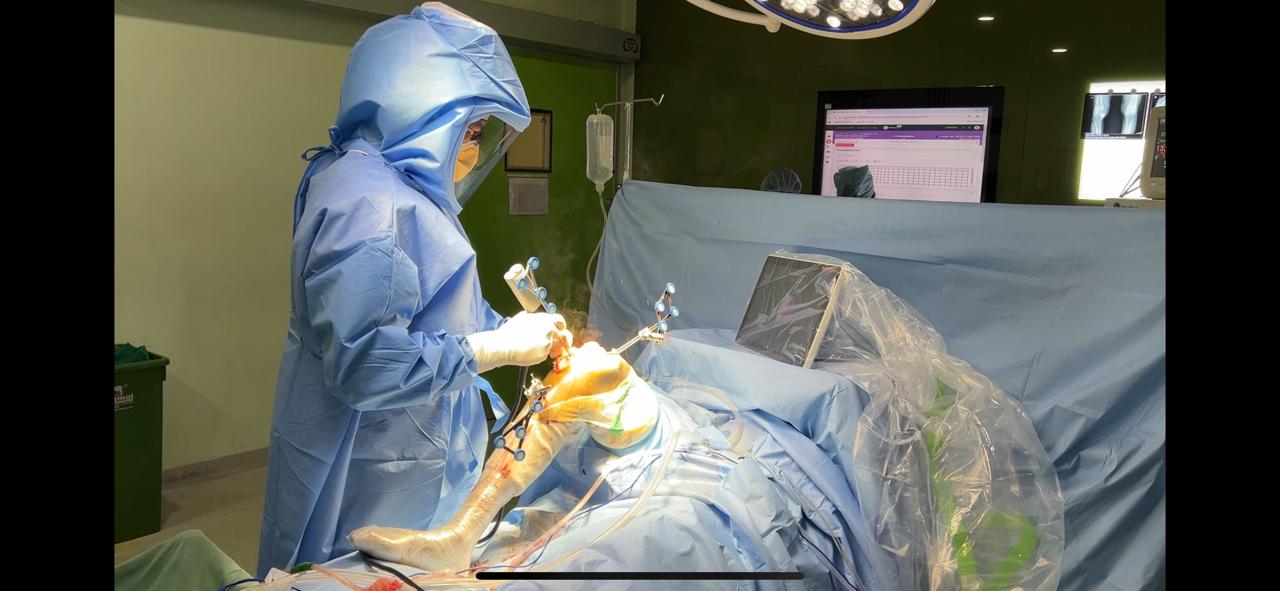
Surgery on a draped joint under theatre lights, in one of the hospital's modular operating theatres.
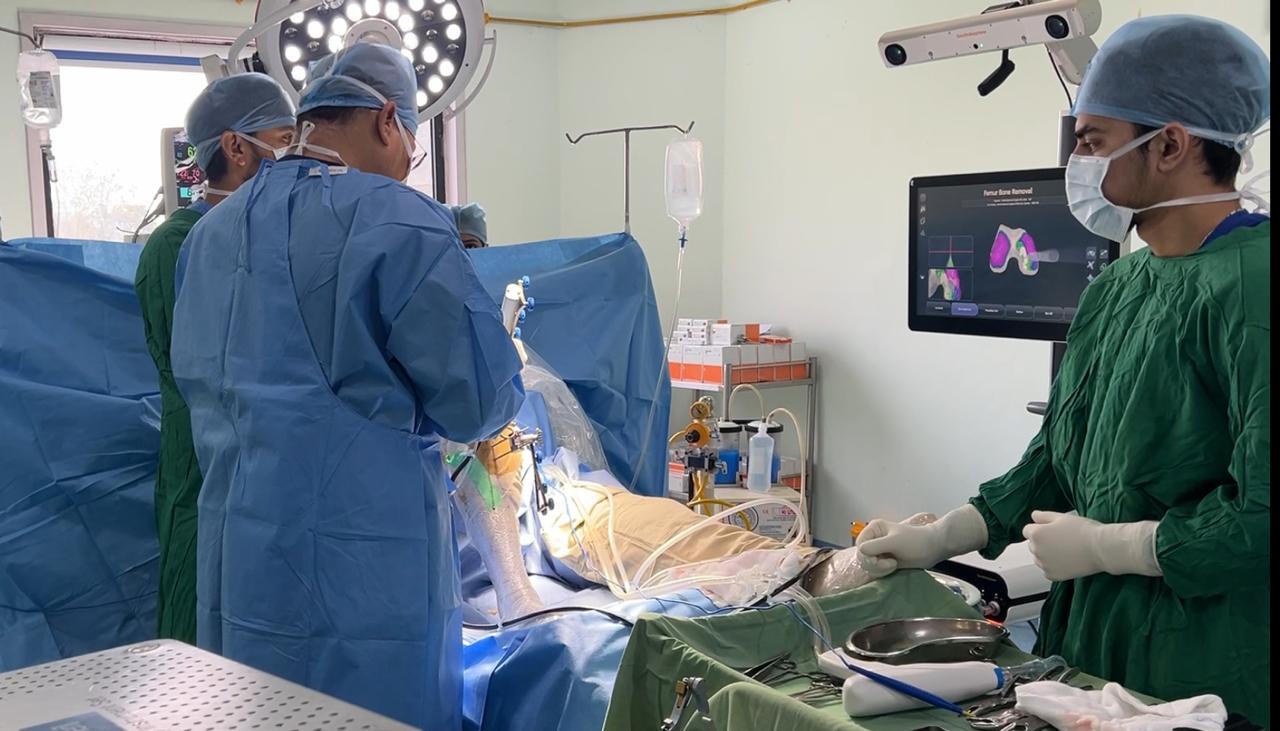
The robot never operates on its own. It is a guiding tool controlled entirely by the orthopaedic surgeon, with the navigation display live throughout.
Robotic knee replacement can be a total replacement or a partial one, depending on which part of the knee joint is damaged. That decision rests on how much cartilage is destroyed, how much pain and swelling you have, and how much your daily function is limited. Only your treating doctor can assess it.
Arthritis wears out the bone surfaces inside the knee. Once tablets and exercises stop holding that in check, resurfacing the whole joint is the option left. Implant size and seating are worked out beforehand against a 3D model built from your own knee, which also lets us tell you in advance which activities you should get back.
Also called unicompartmental knee replacement. The surgeon resurfaces the one worn compartment — usually the medial side, sometimes the lateral — and leaves your healthy bone, cartilage and ligaments where they are. You get a smaller incision, less blood lost, barely any scar, and a knee that still moves much the way yours did.
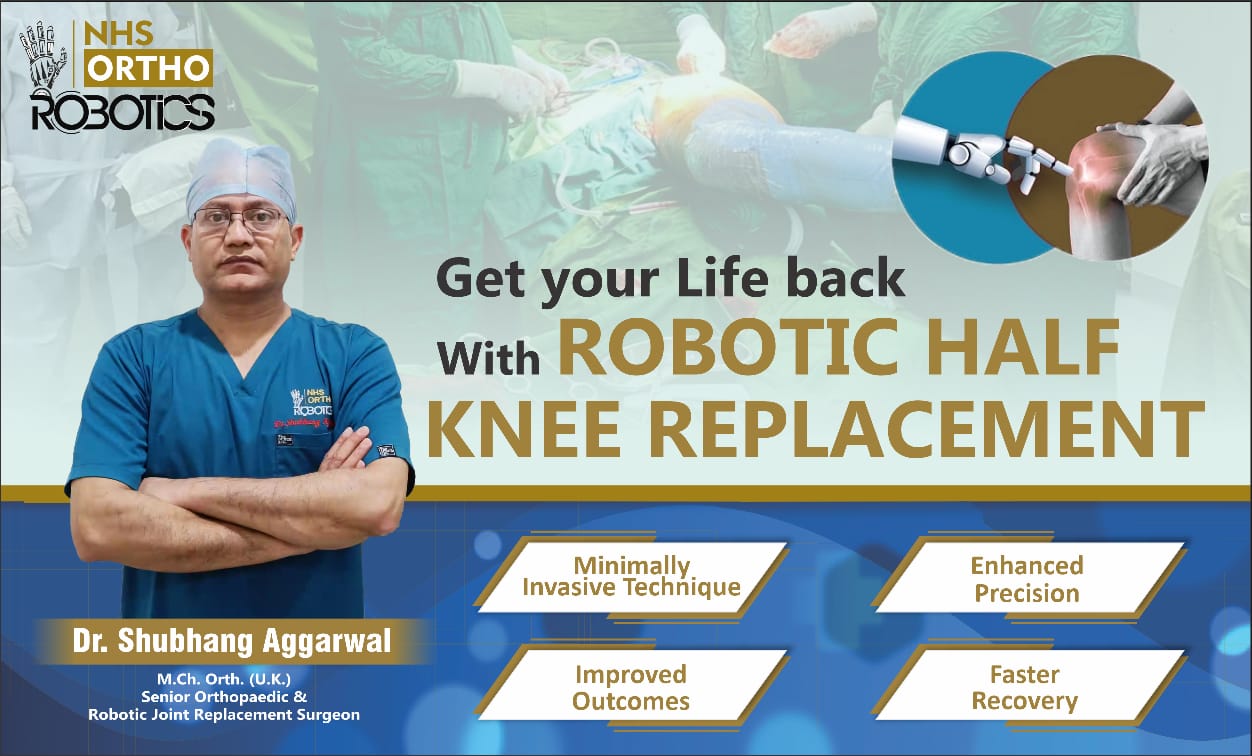
Bring your X-ray or MRI to the consultation. Whether a half knee is appropriate can only be decided after a skilled orthopaedic surgeon examines you and your imaging.
Longevity does not depend on the surgery alone. Alignment, implant material, your weight, your activity level and your rehabilitation all matter. Robotic systems help on the first of those by positioning the implant to millimetre accuracy, which reduces wear over time.
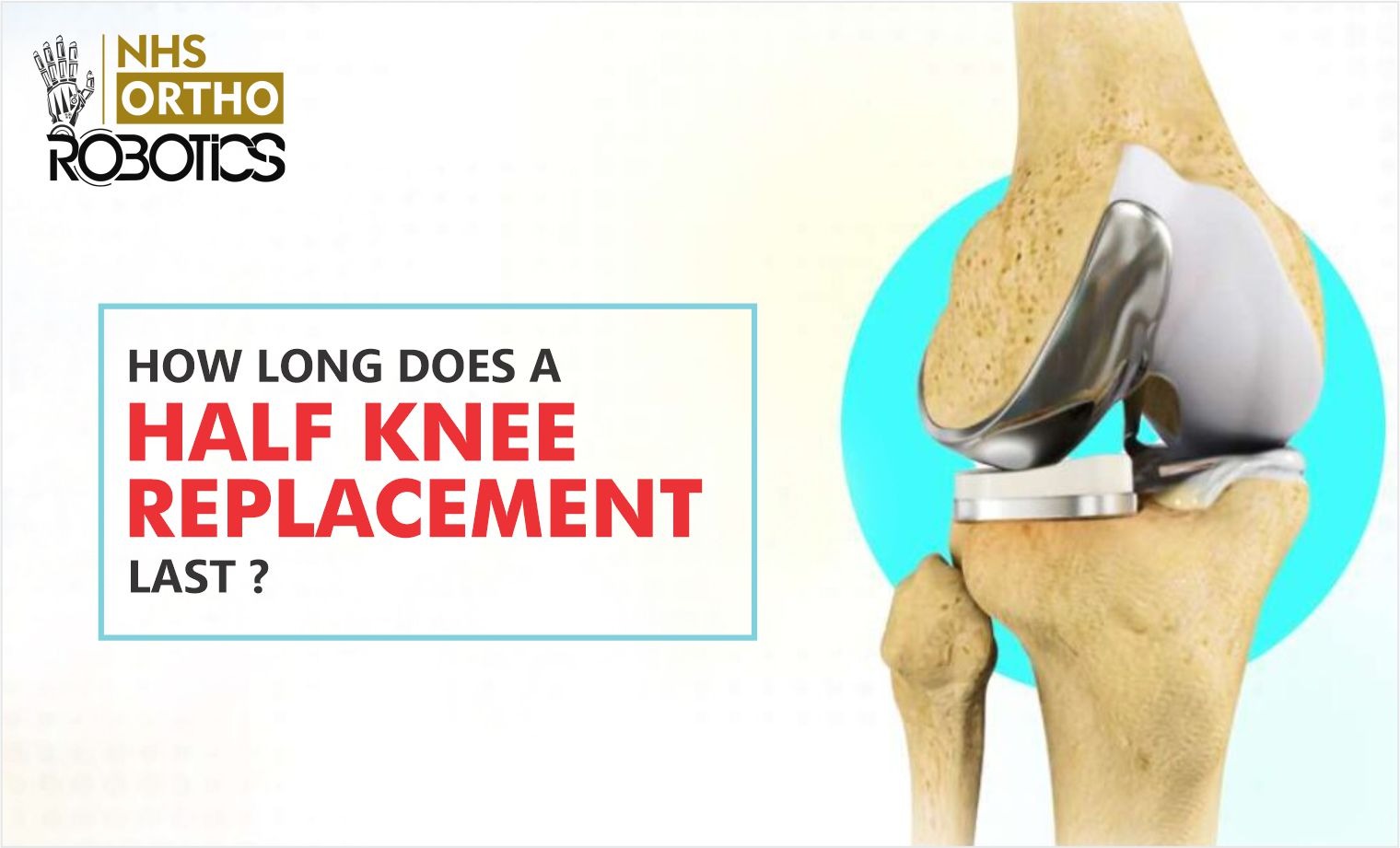
Even a slight misalignment shortens implant life. Robotic assistance controls positioning, alignment and ligament balance.
The bearing pairs high-grade titanium with an advanced polyethylene liner — a combination chosen because it wears slowly and stays smooth under load.
Walking, swimming and cycling strengthen the muscles around the joint. High-impact activity such as running or jumping accelerates wear.
Keeping to a healthy weight reduces the load the implant carries every day.
A structured physiotherapy programme restores flexibility, muscle strength and a balanced gait. Every patient here follows a guided plan.
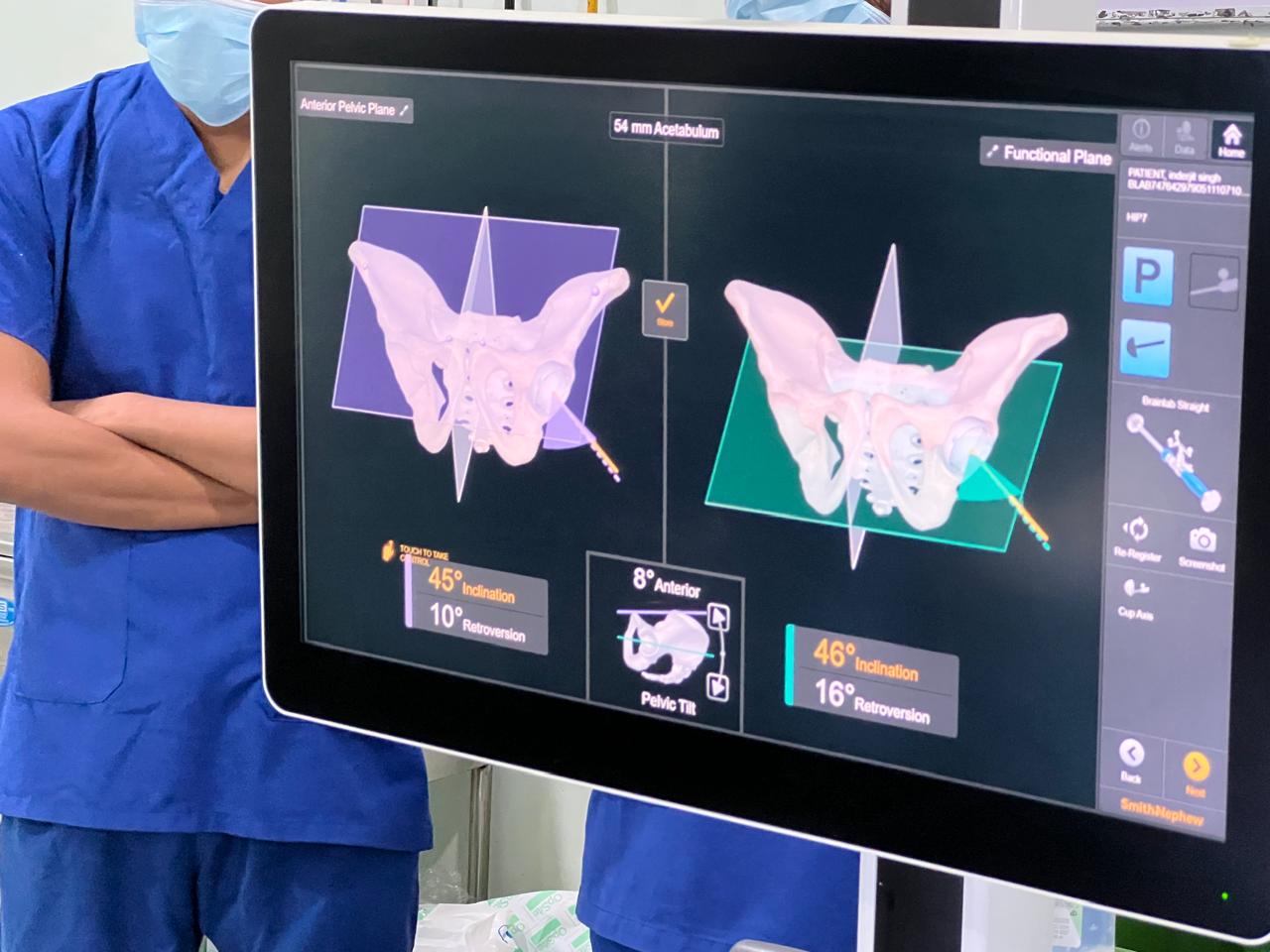
In a total hip arthroplasty the worn joint comes out and a prosthetic implant goes in — that is what takes the pain away and gives you your movement back. How the hip feels afterwards is largely down to where the cup sits, so inclination and anteversion are settled on a 3D model of your pelvis before a single implant is opened.
For arthritis and hip pain that no longer responds to conservative treatment.
Redoing a previous hip replacement that has loosened, worn or failed. Also offered for knee and shoulder.
Hip and knee preservation surgery is also part of the service, so replacement is not the automatic answer for everyone who walks in.
The department covers knee, hip and shoulder replacement, spine surgery, sports injury and trauma, and a full range of care for musculoskeletal conditions, from diagnosis through to physiotherapy.
Beyond joint replacement, the department runs paediatric orthopaedics, scoliosis and spinal deformity, and sports medicine, with physiotherapy and bone density screening in-house.
Arthritis is the word for bone surfaces inside the knee that have worn out. Once tablets and exercises can no longer keep it under control, replacing the joint enters the conversation. Robotic knee surgery is the advanced technique used for that today, performed as a total or a partial procedure depending on which part of the joint has gone.
Bone, joint and back problems in children, managed with or without an operation. Bones that are still growing behave differently, which is why this is its own specialist service and why the surgeon's training matters. Reasons to bring a child here include a curve in the spine, walking that is not normal, developmental delay, skeletal dysplasias, a tumour, crooked limbs, broken bones and legs of unequal length.
Treatment is graded to the curve. A mild bend can be managed with physiotherapy and medication. A moderate bend may need physiotherapy or a brace (thoracolumbosacral orthosis, or TLSO back brace), and in some cases surgery. For a severe curve, surgery is the solution.
Rest, immobilisation and physiotherapy come first. Where they do not work, or the damage is severe, surgery follows: plates, wires, screws or rods for broken bones, a new natural or artificial ligament for a torn knee ligament, and arthroscopic techniques for shoulder ligament injuries and rotator cuff tears. Tendonitis, dislocations, injuries to the AC joint of the shoulder and cruciate ligament tears are all managed in this clinic.
Every week somebody puts off an operation because of something they heard. These are the six we field most often in the OPD, answered plainly.
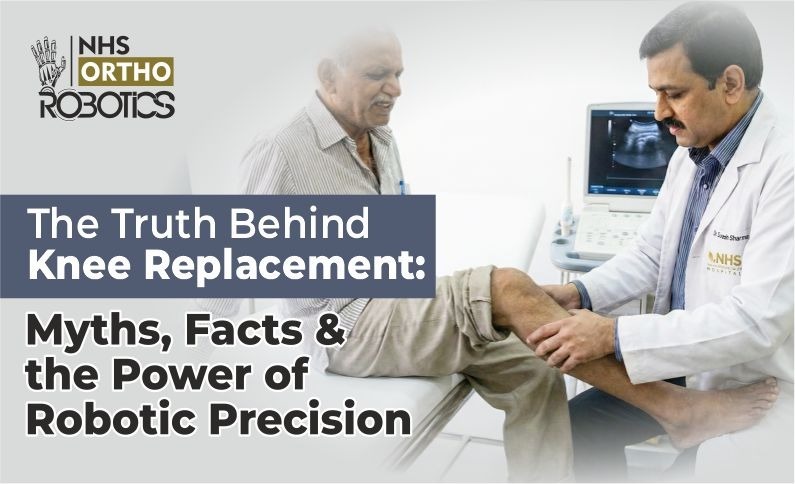
Fact: What we weigh is how far the joint has been destroyed and how much that is costing you day to day — not the number in your file. Someone much younger, carrying advanced arthritis, an old injury or a deformity, can be an entirely reasonable candidate.
Fact: The robotic route starts with a precise 3D plan of your knee drawn before the first incision, so less tissue is disturbed and rehab moves along sooner. Plenty of patients are on their feet inside the first day and back in their normal routine earlier than they had braced for.
Fact: Nothing happens without the surgeon. Your orthopaedic surgeon drives the system from start to finish; its job is to map the knee joint live and hold every cut inside sub-millimetre tolerance.
Fact: Cared for properly, a current implant runs 25 to 30 years and often beyond. Wear slows when alignment is correct and load is spread evenly across the joint — which is exactly what the robotic accuracy is buying you.
Fact: Most people finish up moving better than they did before the operation. Once recovery is behind you, stairs, cycling, walking and the rest of your day are all back on the table.
Fact: The map is drawn from your anatomy, the bone cuts follow that map, and ligament balance is tuned to your own structure. Those are measurable differences in accuracy and safety, not a sales line.
People heal quicker when they are not anxious, and they are far less anxious once they know the sequence. So here is the route a joint replacement takes at this hospital, step by step.
Schedules, cost estimates and logistics are discussed up front. Pre-anaesthetic checkups are started, medication is adjusted and insurance approval is verified beforehand so nothing is delayed on the day.
Imaging and pathology are done in-house, digital reports sync immediately, and the senior consultant reviews them. Any input needed from other departments is lined up at this stage.
The operation is planned on a 3D model of your joint and carried out to that plan. Your senior consultant supervises the inpatient stay, with intensive care physicians and nursing teams on the floor at every hour of the day.
Walking with support usually starts inside the first 24 hours, and half knee patients frequently go home the same day. Discharge hands you a medical summary, the medicines to take home, instructions for the wound and for diet, and numbers to ring in an emergency.
Expect 6 to 8 weeks of physiotherapy before you are fully back. The folder you go home with sets out what to eat, which exercises to do and when to return, and the nursing station rings you for tele-monitoring check-ins in between.
A dedicated TPA desk handles pre-authorisation, queries and settlement directly with your insurer. Bring your policy card and photo ID to the cashless desk when you are admitted — clearance normally comes back within two to four hours. If you would rather know before you travel whether robotic joint surgery is covered, email that same card with your doctor's recommendation to info@nhshospital.in.

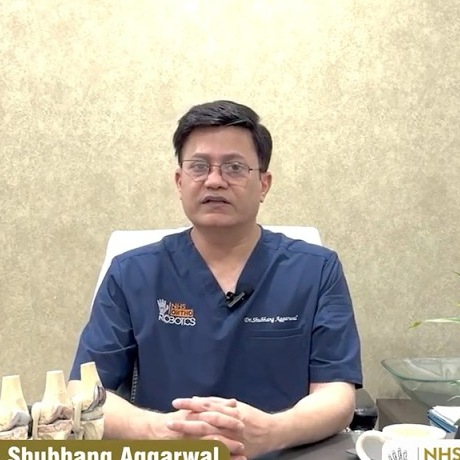
M.Ch. Orth (UK) · Senior Orthopaedic & Robotic Joint Replacement Surgeon
Trained abroad, practising here as a senior consultant, and the man who built the robotic joint replacement programme at NHS Hospital Jalandhar. Thousands of joint replacements sit behind him, and referrals reach his clinic from right across north India. He heads the department as Director of NHS Ortho Robotics, with more than twenty years of operating behind that title.
NHS Hospital serves families across Punjab, Himachal Pradesh and Jammu & Kashmir, and runs a dedicated international desk for patients travelling from abroad for joint replacement.
Complex cases are planned by the team, not by one person working alone. Where a joint problem overlaps with cardiac, neurological or kidney issues, the relevant specialists align before anyone operates.
Trauma is his daily work, alongside complicated surgery on bone and joint. His clinical interests run through foot and ankle surgery, PRP therapy and joint replacement, and he builds the plan around the patient in front of him rather than the diagnosis on the file. OPD Monday to Saturday, by appointment.
Specialises in complex spine deformity correction and works alongside Dr. Shubhang Aggarwal on the scoliosis service, from screening and bracing through to surgical correction and post-operative rehabilitation.
A joint replacement is only as good as the theatre, the imaging and the recovery that surround it. NHS Hospital is a 200-bed tertiary care institution with 45 critical care beds and 31+ super-specialists on site.
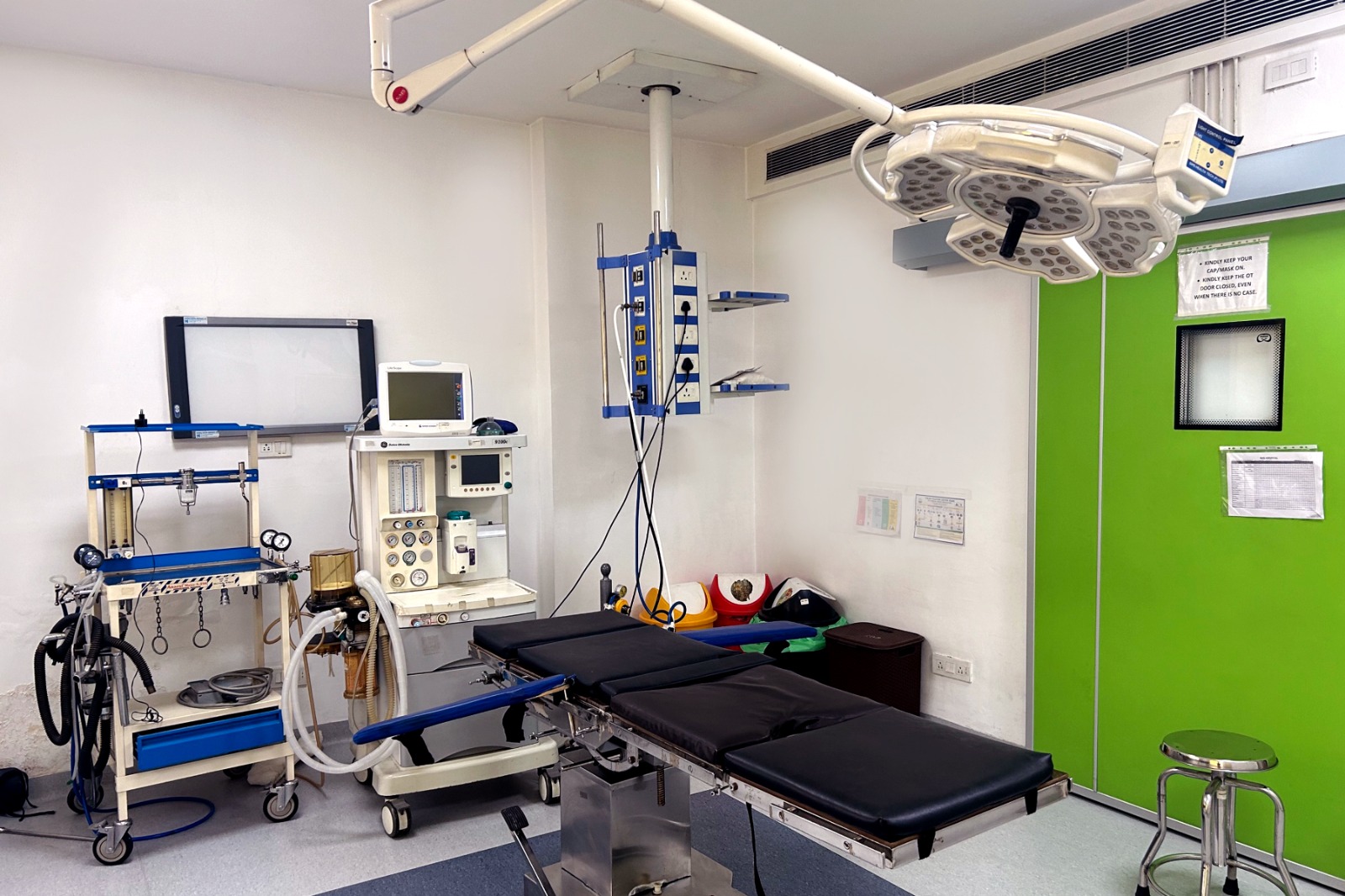
Digital theatres running laminar flow and high-efficiency particulate air (HEPA) filtration, which strip airborne contaminants out of the room while you are on the table. Imaging streams in live and the paperwork is entirely electronic.
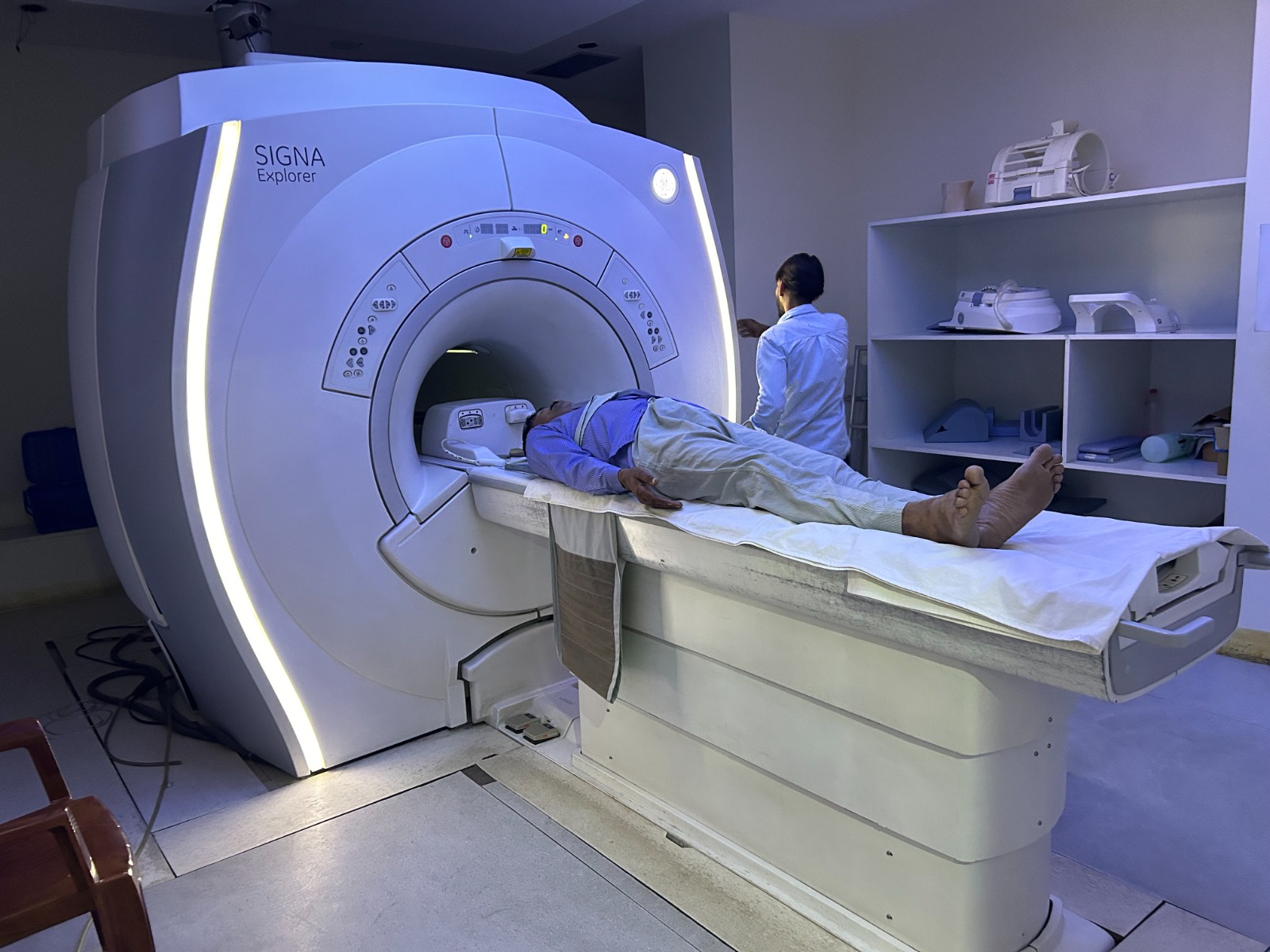
Silent MRI (GE), low radiation CT (Revolution ACTs ES), digital X-ray, fluoroscopy and bone densitometry, all in-house. MRI and CT run 24 hours for emergencies.
Followed for every single operation, and audited regularly by the internal hospital quality committee.
Nothing reaches a theatre until it has cleared both chemical and biological sterilisation checks.
Consultant-led intensive care surveillance round the clock, with the ICU swabbed and tested regularly.
Densitometry with osteoporosis management, so weak bone is identified and treated rather than discovered late.
No stock photography here. Every frame below was taken inside NHS Hospital, Jalandhar — the robot, the theatre it stands in, the team that runs it and the ward you recover on. Tap any picture to open it full size.
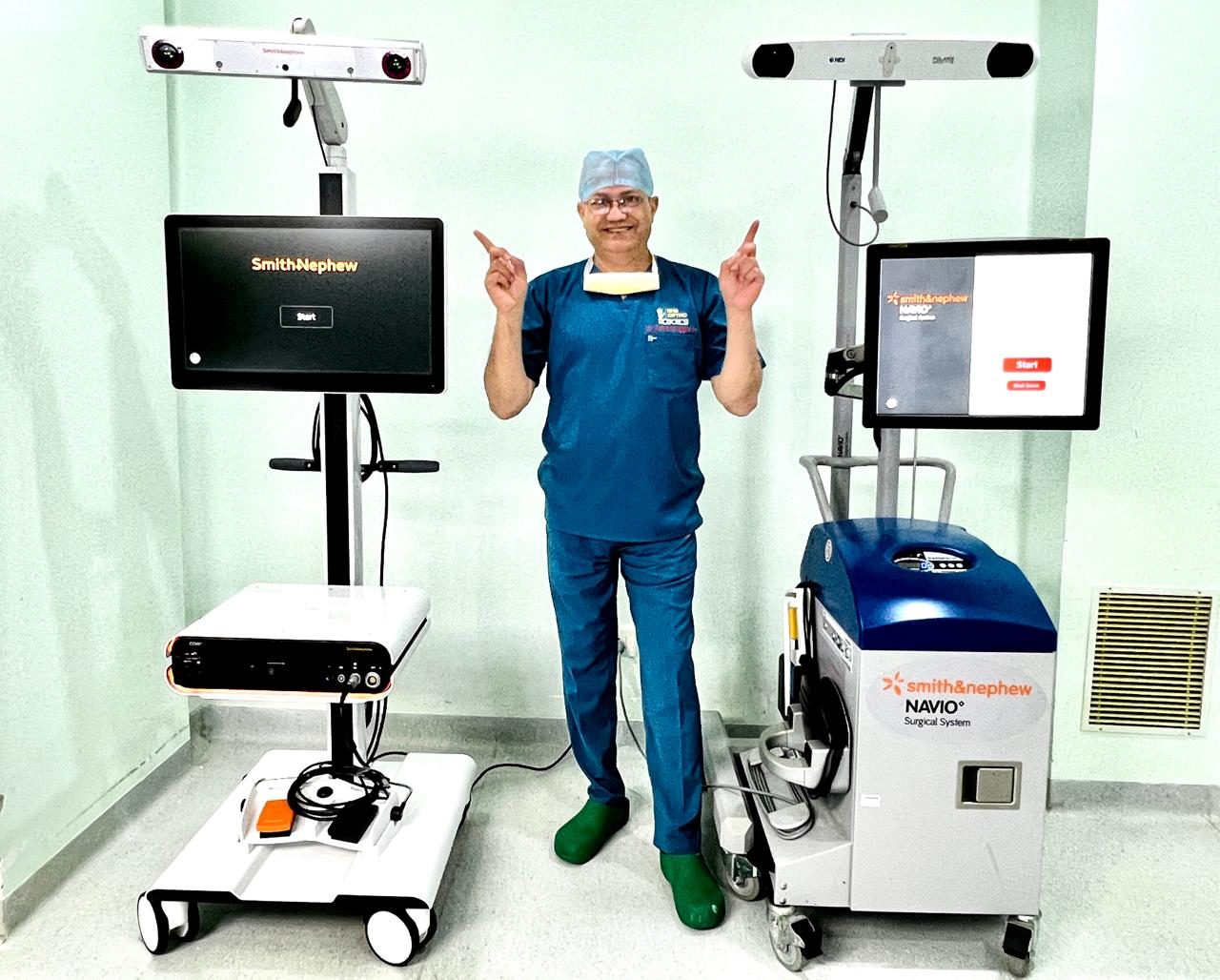
Surgeon with the NAVIO robotics platform in theatre
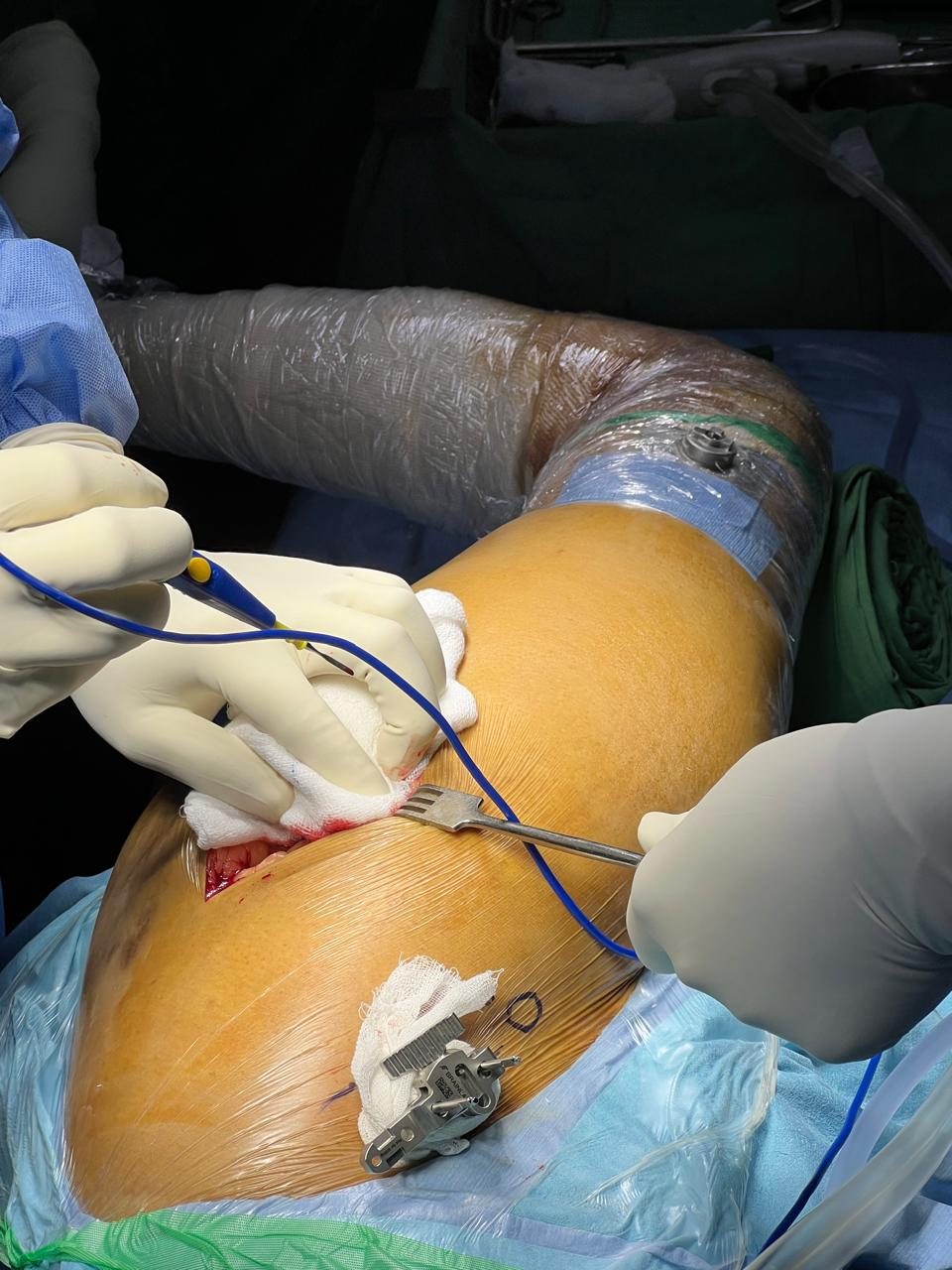
Optical tracker arrays fixed to bone during robotic knee surgery
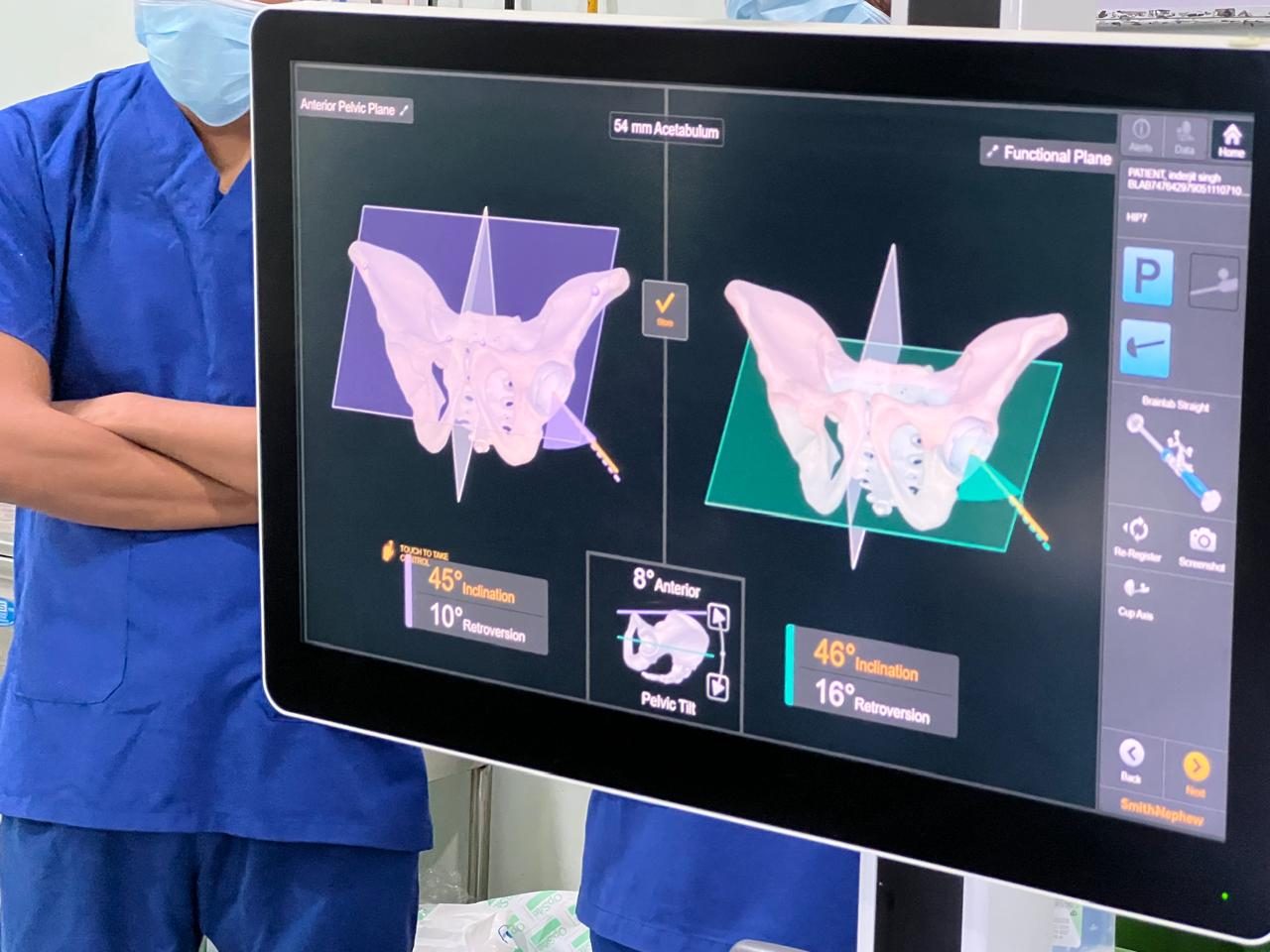
Robotic navigation screen — 3-D hip planning with cup angles
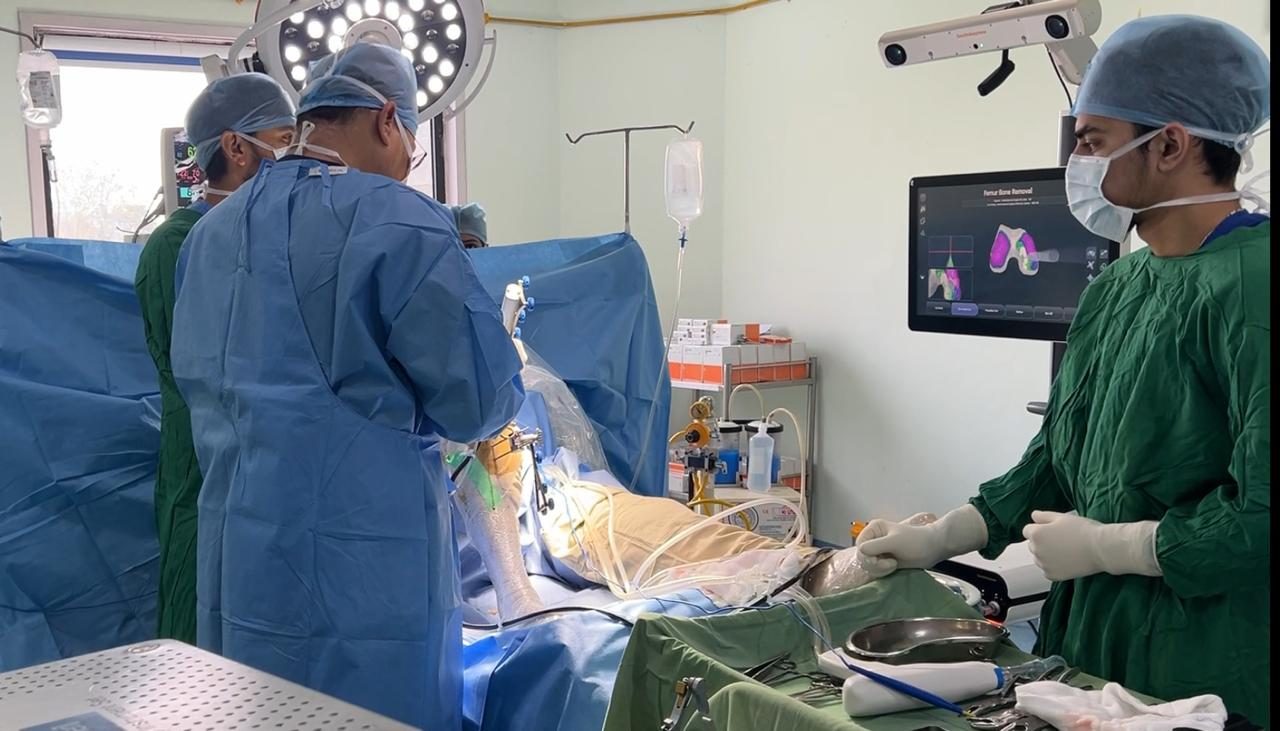
Navigated joint surgery with the planning screen live in theatre
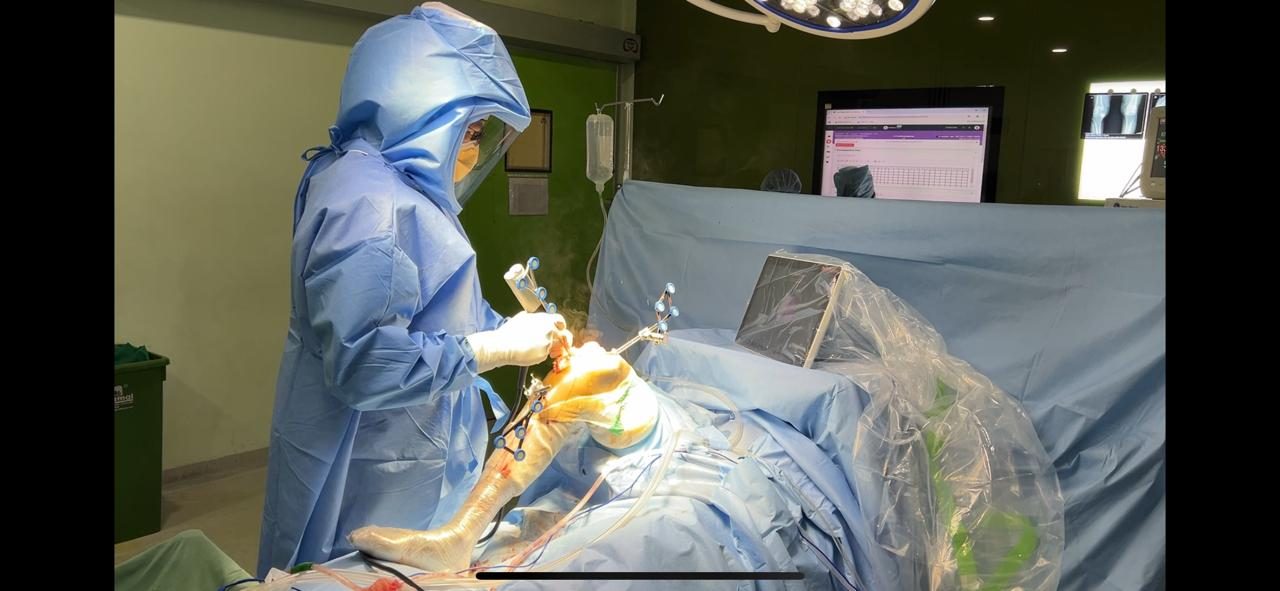
Joint replacement surgery under way
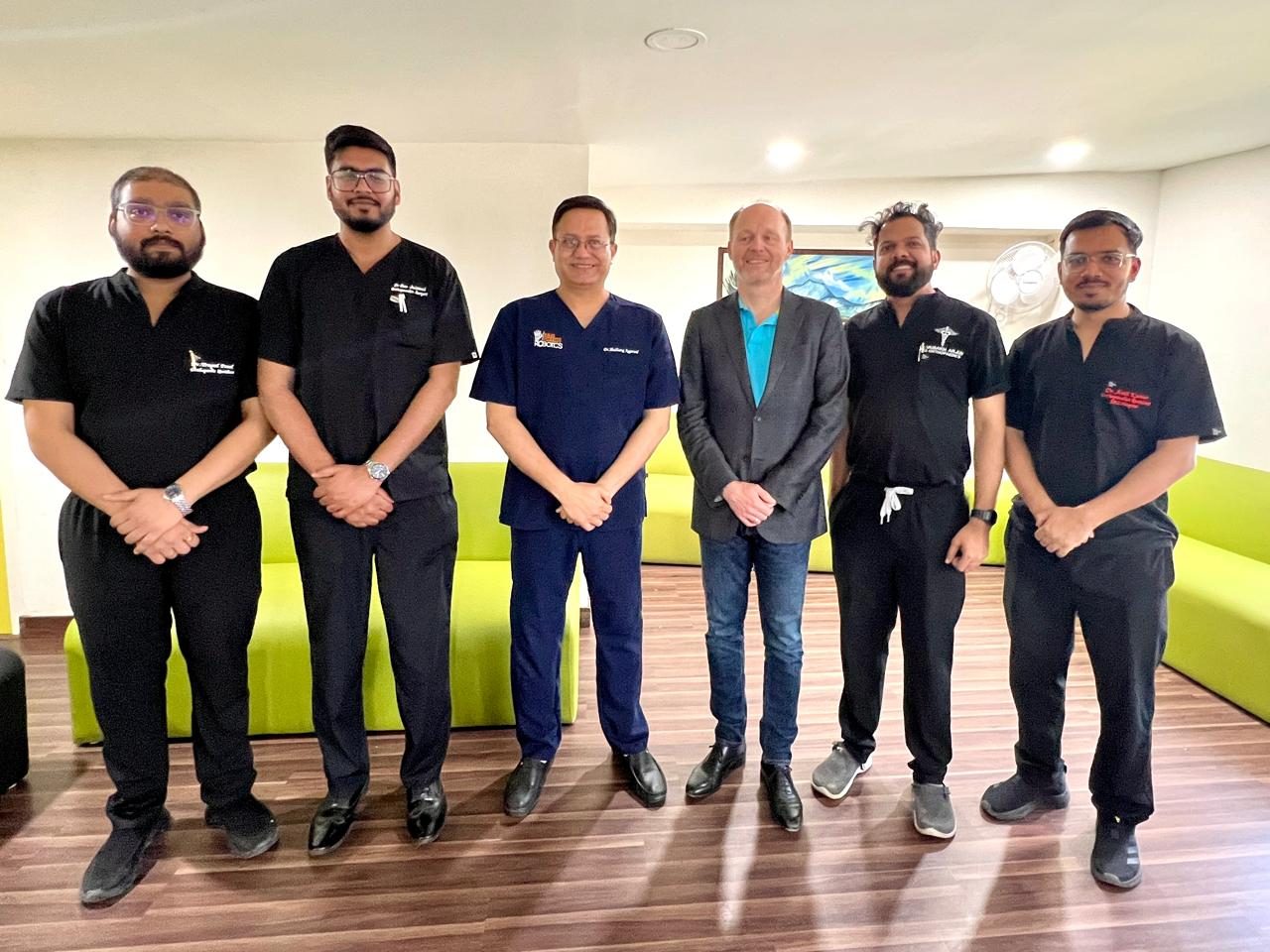
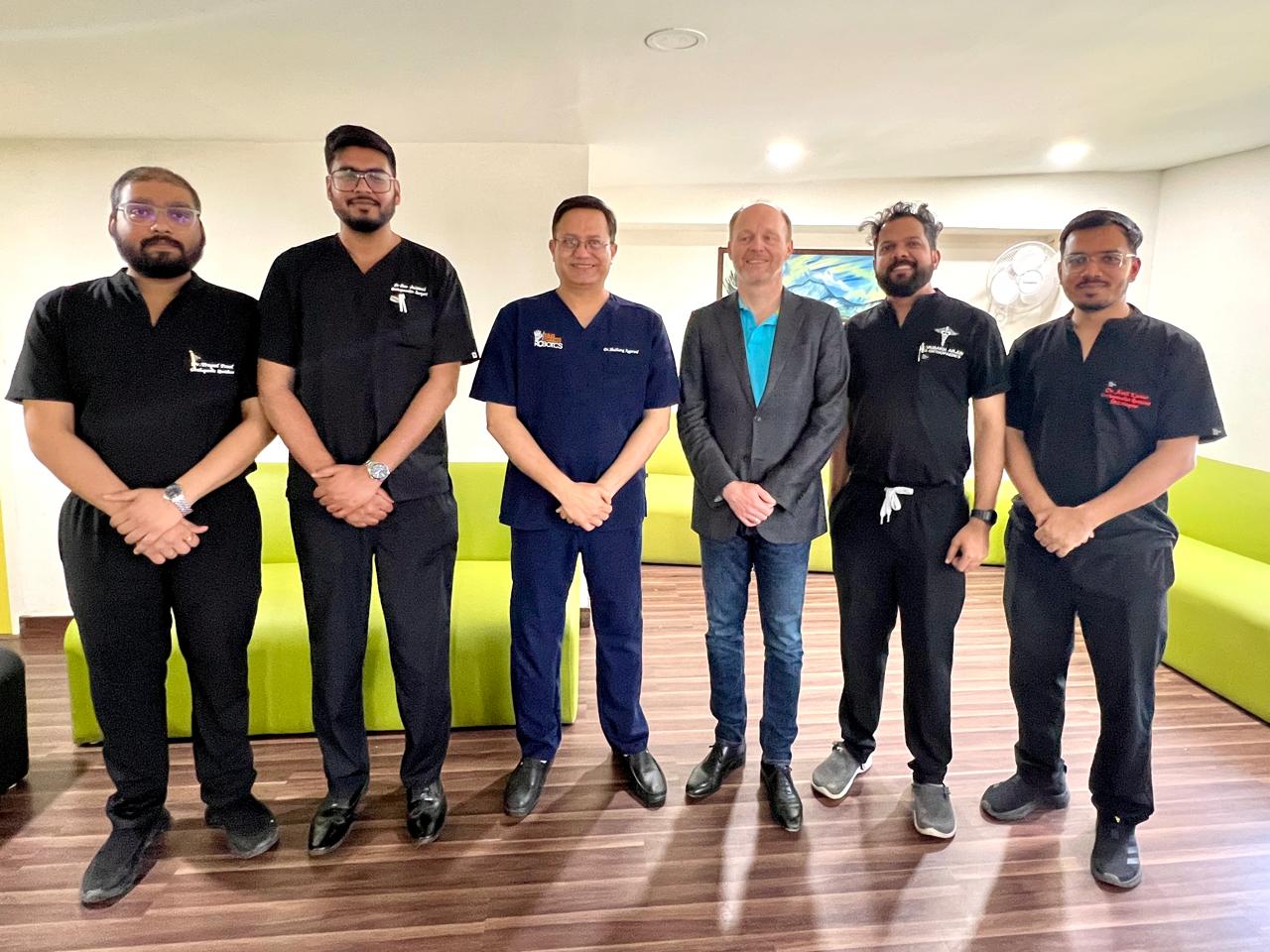
The robotic joint replacement team
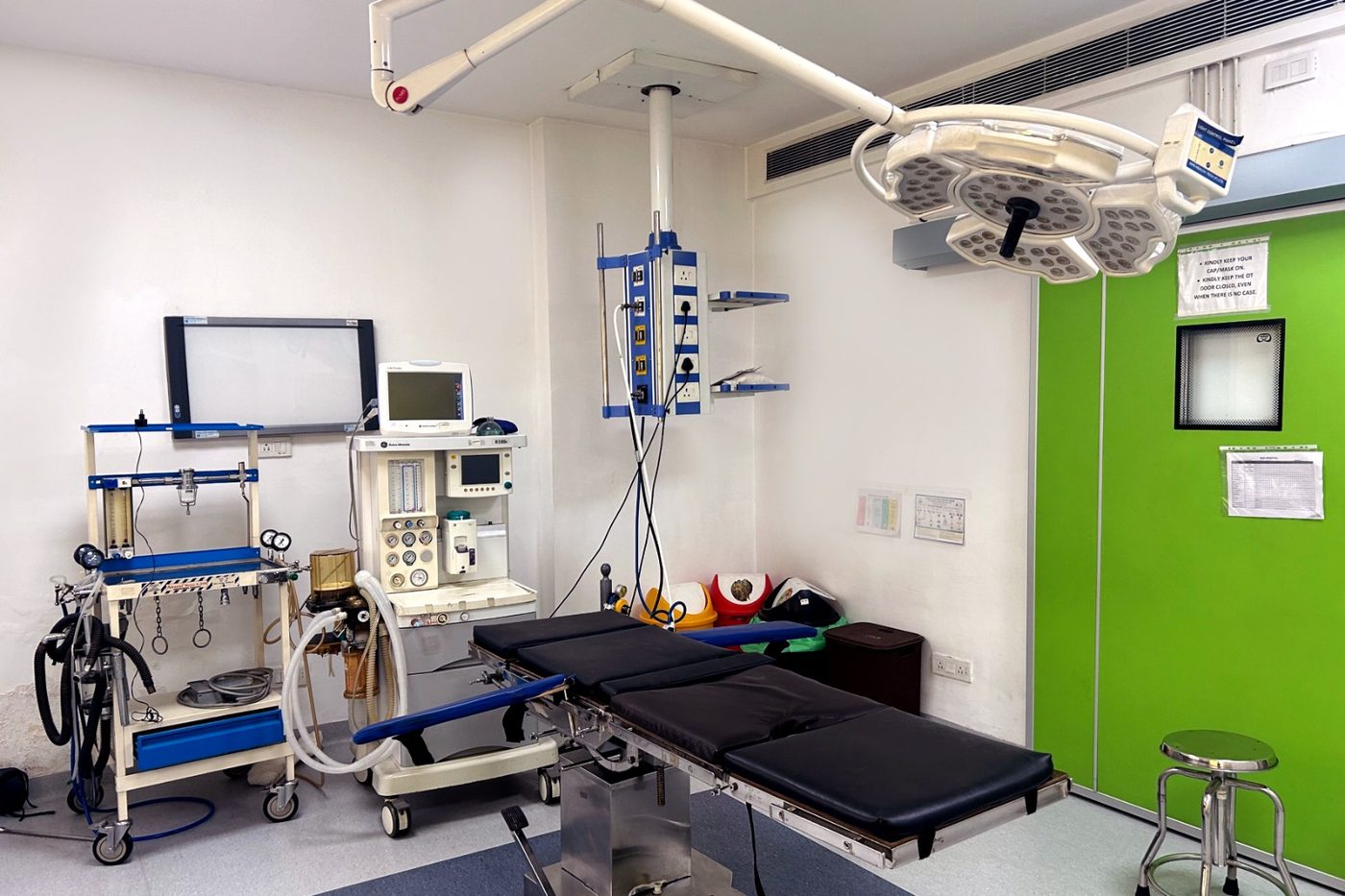
Modular operation theatre
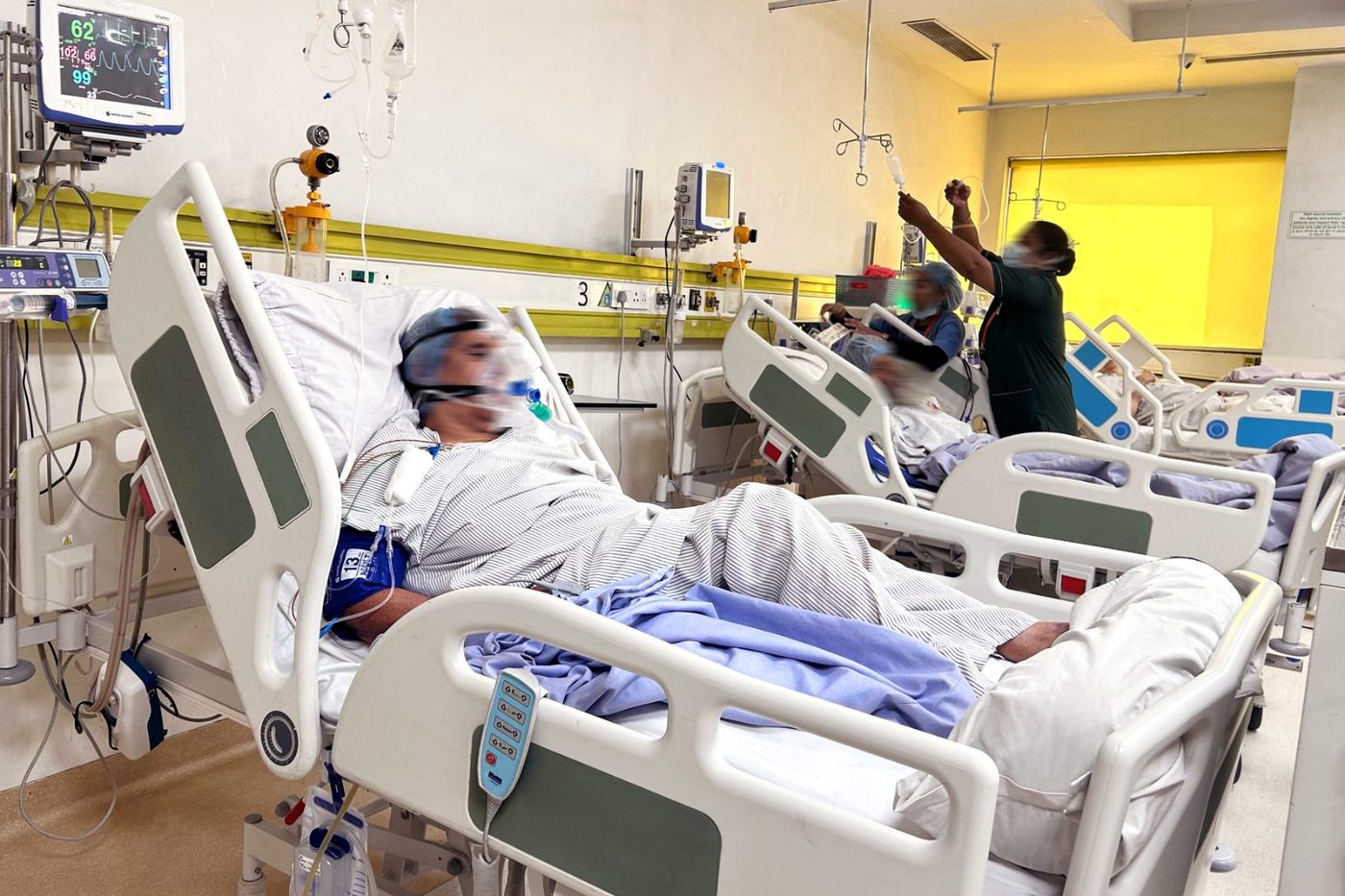
Inpatient ward
Not everyone who comes through this department needs a joint replaced. A large part of the work is spinal curvature in adolescents, growing bones in children, and back pain in adults.
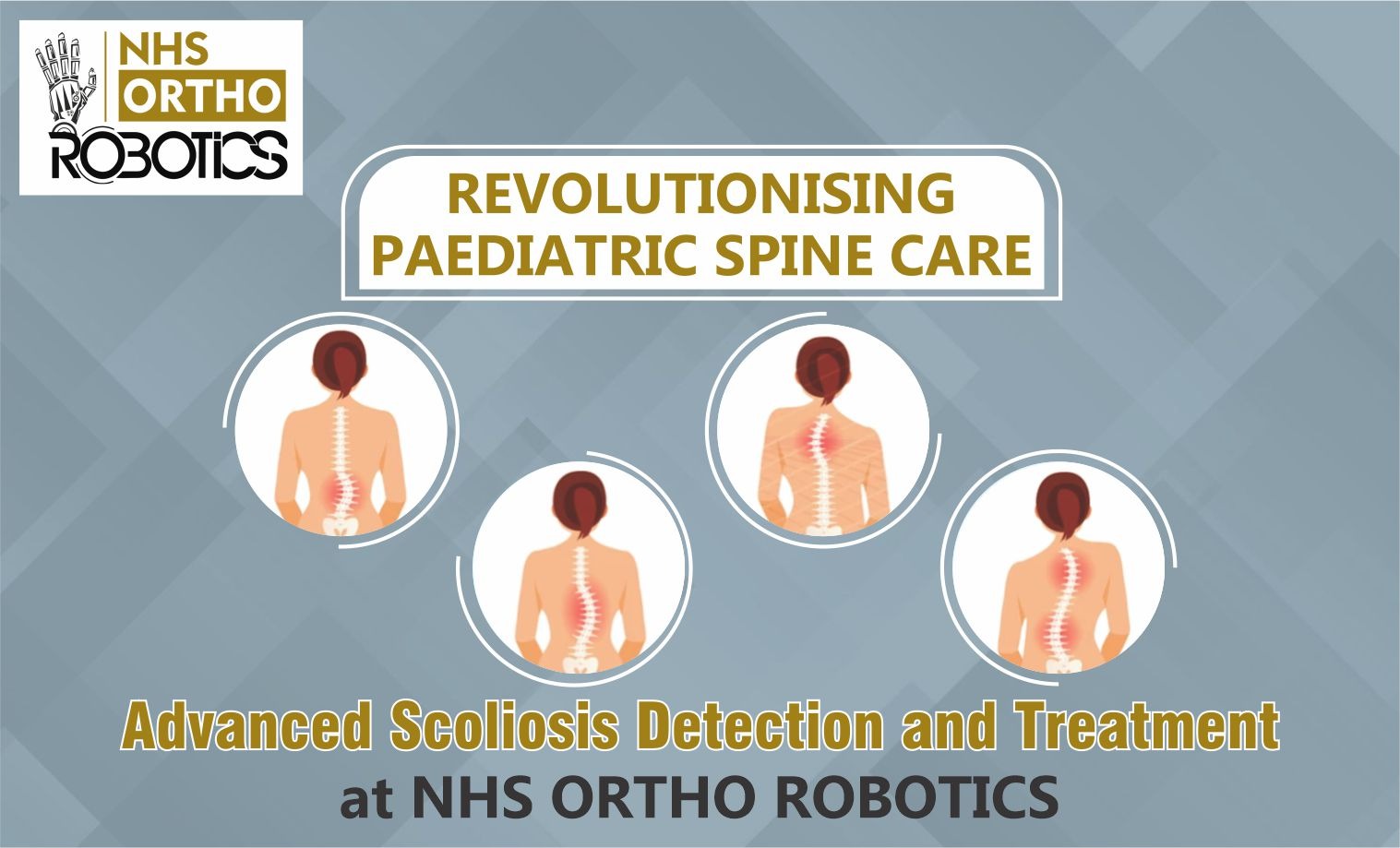
In scoliosis the spine bends sideways where it should not, taking a C or an S shape. The cause may be congenital, it may be neuromuscular, or it may be idiopathic — meaning nobody can say. A small curve sometimes needs nothing beyond watching. A severe curve, or one that keeps progressing, has to be treated: left alone it grows with the child and begins to interfere with the lungs and the heart.
Curves are measured on 3D spine imaging alongside posture analysis. A mild one is usually held in check with custom bracing, physiotherapy and posture work. Once a curve is moderate or severe, the correction is mapped digitally and carried out with robotic assistance, with physiotherapy and muscle strengthening filling the months afterwards.
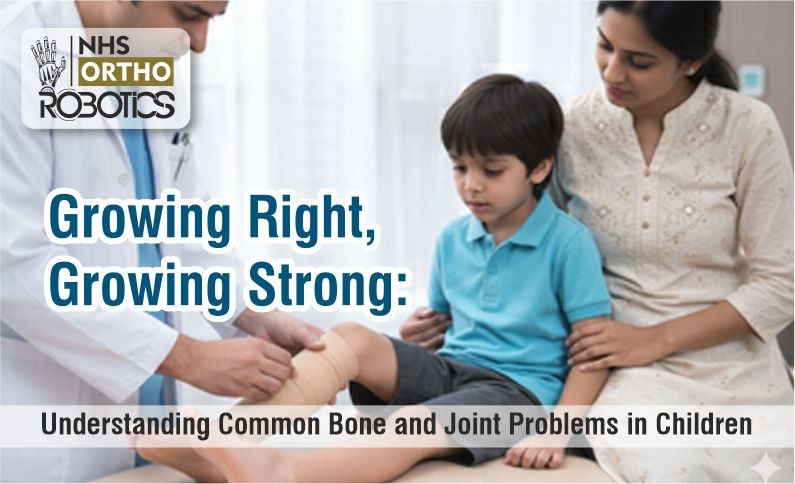
A child's skeleton is still being built. It is not an adult skeleton in miniature, and a bad fall or an untreated deformity during that building phase can shape how the child stands, and how comfortable they are, for decades afterwards.
Joint pain or swelling that will not settle. A limp, or a gait that looks uneven. A leg that seems shorter or more bowed than its pair. Trouble bending down or managing a flight of stairs. Walking milestones that are arriving late.
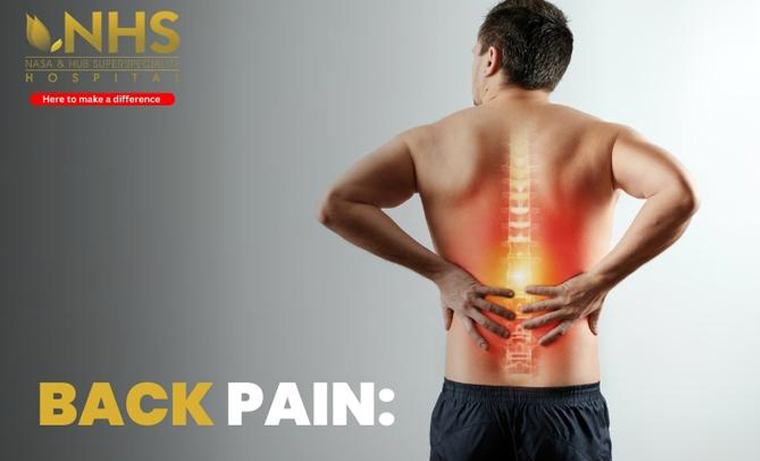
Twenty-four vertebrae sit one on top of another, cushioned by intervertebral discs, strapped together by muscle and ligament, with small facet joints running the length of the column. Any one of those parts can be where the pain is starting.
Radicular pain that travels down a nerve into the leg, and muscle spasms that lock you up, both need assessment. Surgery is a last resort, considered only when rest, physical therapy, medication and injections have failed to give relief.
"My friend from Kashmir underwent a knee surgery from NHS Hospital Jalandhar. We were hopeless if he'll be able to walk again or even resume playing volleyball. But thanks to Dr Shubhang Aggarwal for the treatment and incredible services of NHS staff that he is as fit as before. Patients get reminder messages and a call from reception before time. Hospital staff is very punctual and polite."
"Our experience from the reception to the MRI Center and other laboratories was just perfect. The minute we entered I think half the battle was won as the whole hospital gave such confidence and a positive vibe. I wish Dr. Shubhang Aggarwal and his team members all the very best for this state of art hospital."
"Very good team of doctors in the modern equipped hospital. The hospital is very neat and clean with good infrastructure. The staff is also very polite and empathetic."
Recovery journeys recorded at NHS Ortho Robotics, in the patients' own words.
6-7 Years of Knee Pain to Confident Walking
10 Years of Knee Pain to Confident Walking
Reverse Shoulder Arthroplasty Recovery
Walking Without Pain After Robotic Knee Surgery
Fast Recovery After Robotic Knee Replacement
Why I Chose Robotic Knee Surgery
ACL Injury Recovery Journey
Left Tibia Implant Removal Recovery
How NHS Ortho Robotics Transformed My Knee Surgery Journey
How Robotic Knee Surgery Transformed My Life
From Pain to Mobility — Robotic Knee Surgery
From Injury to Recovery at NHS Ortho Robotics
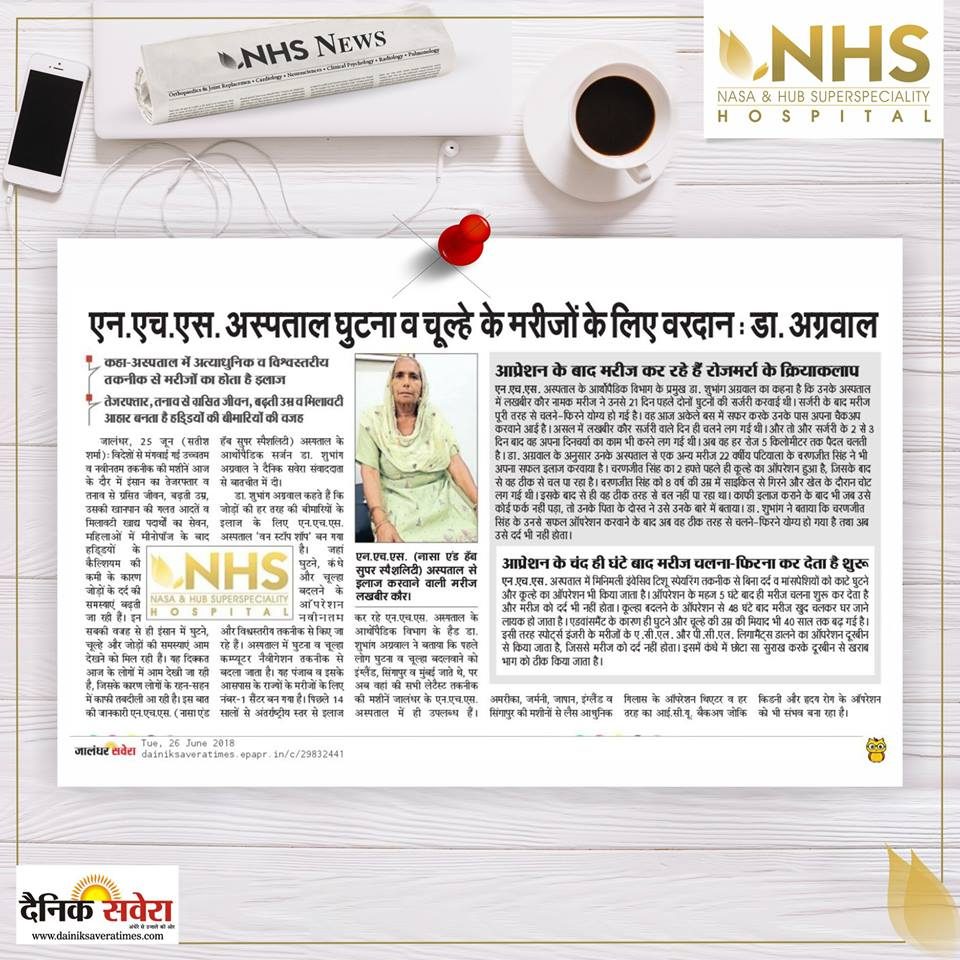
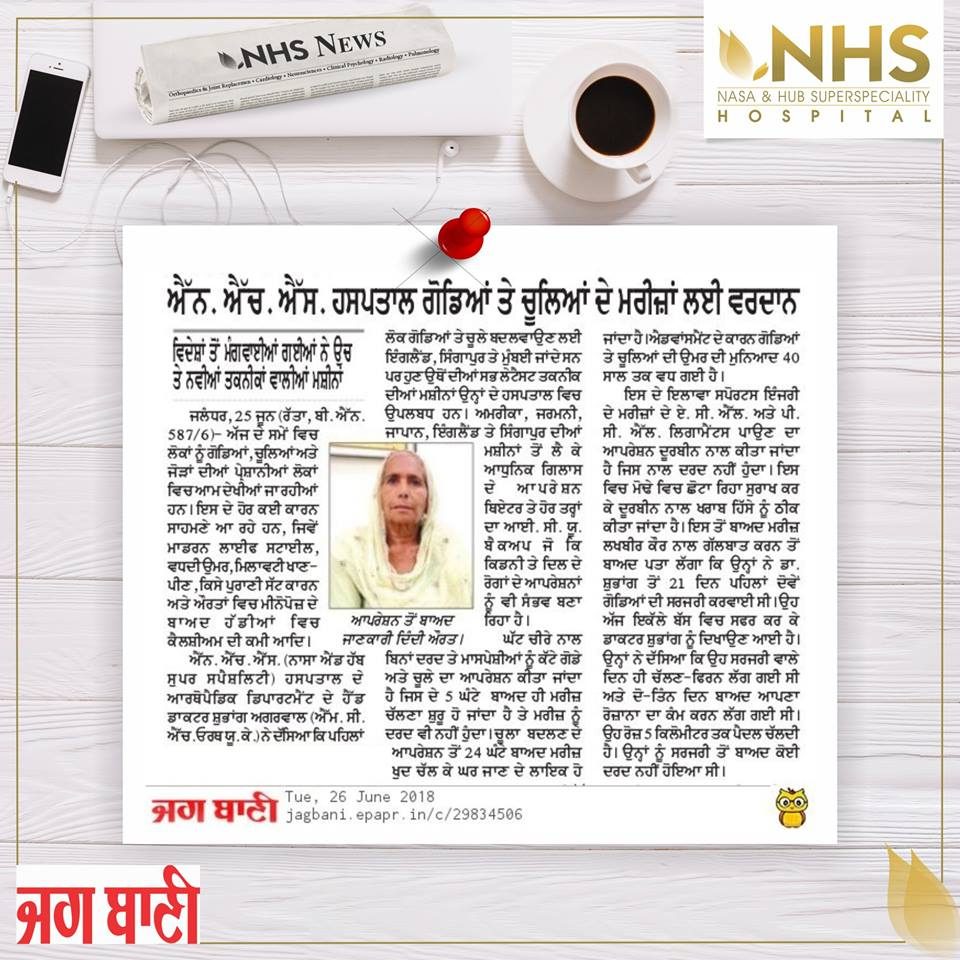
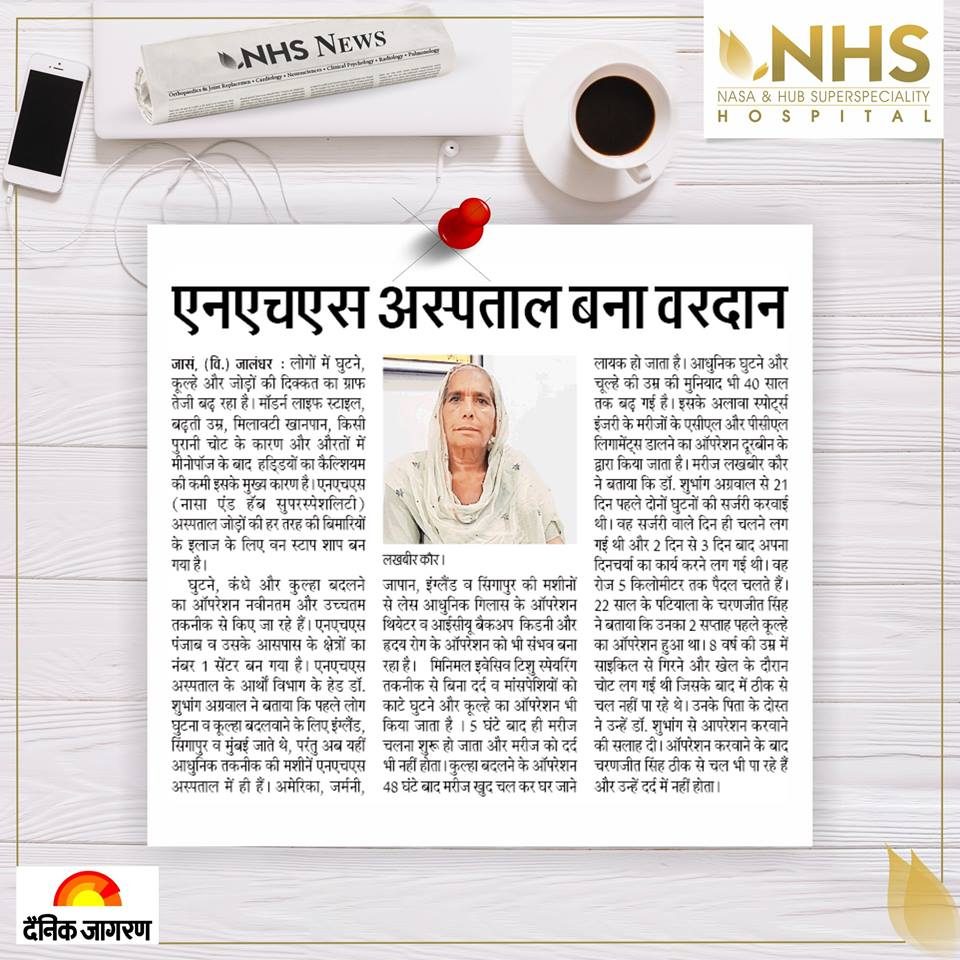
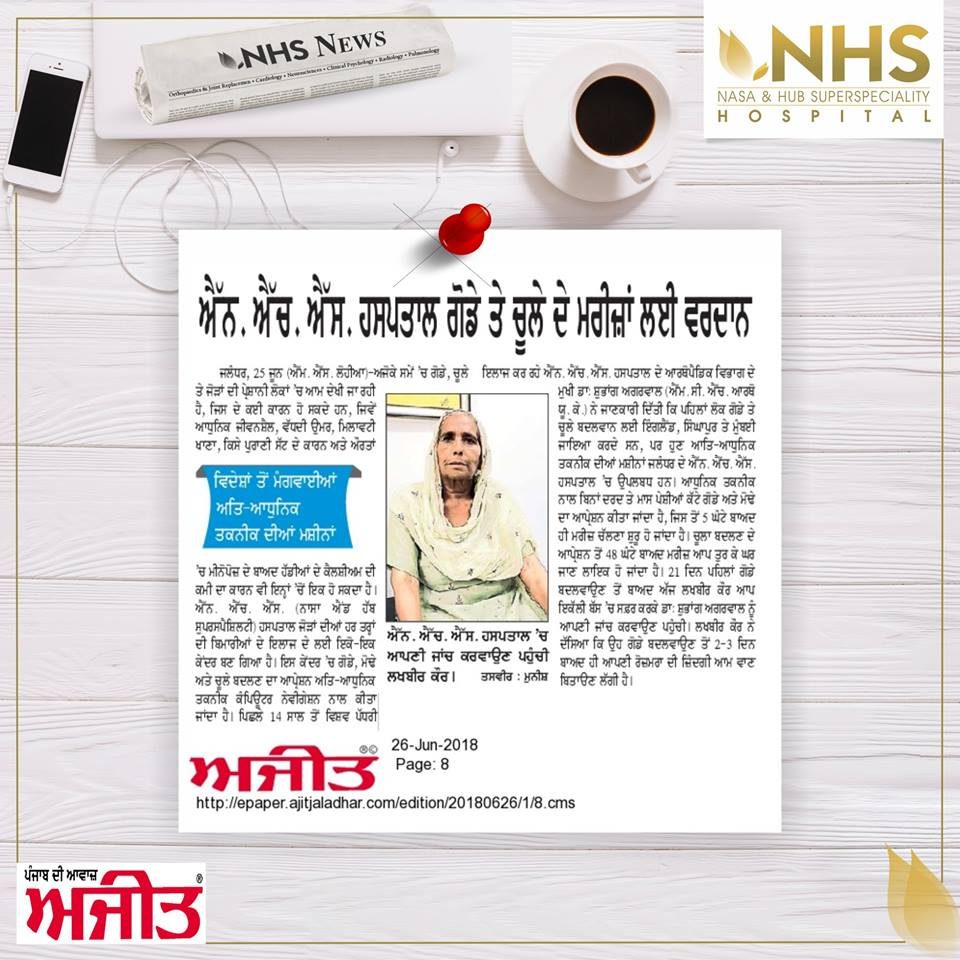
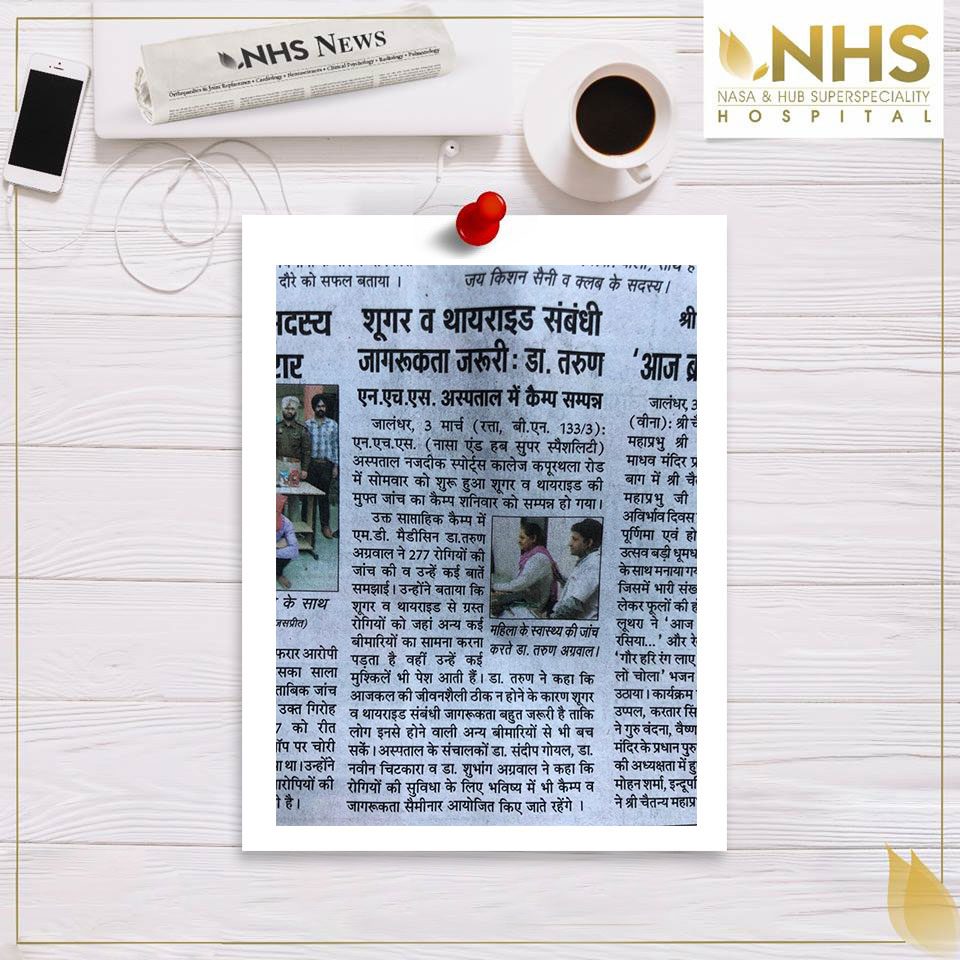
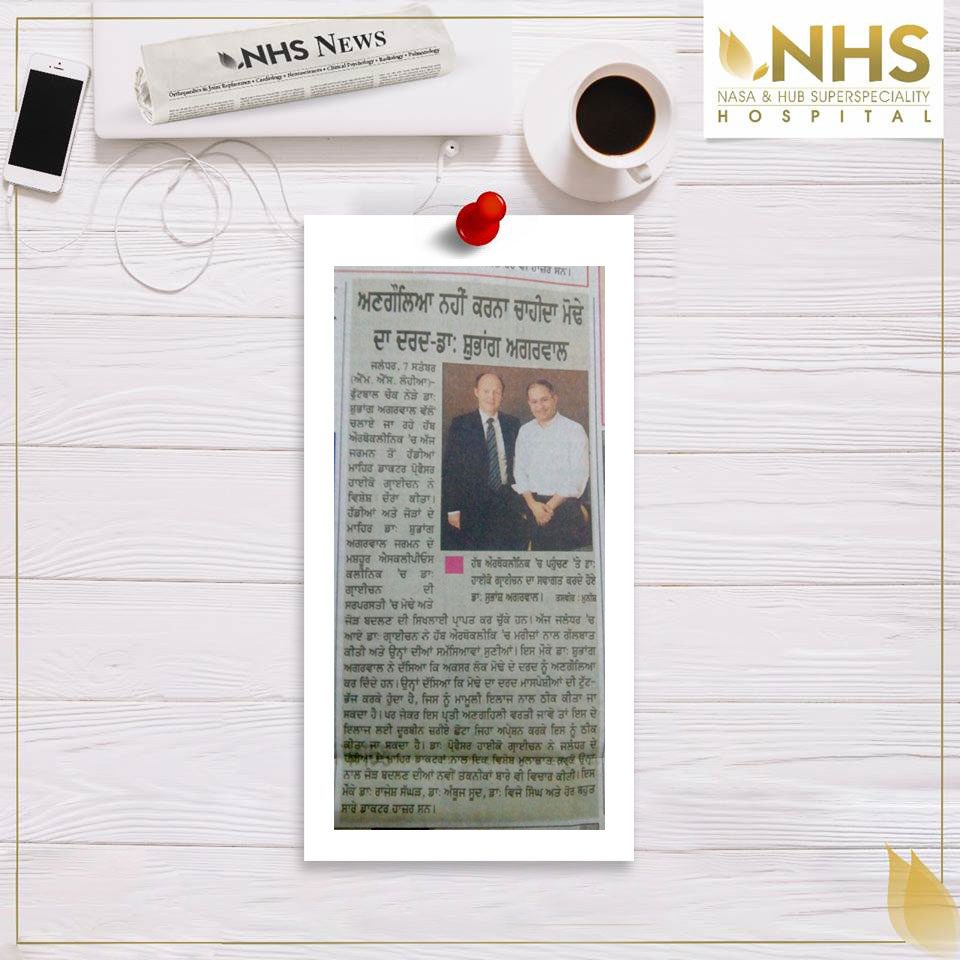
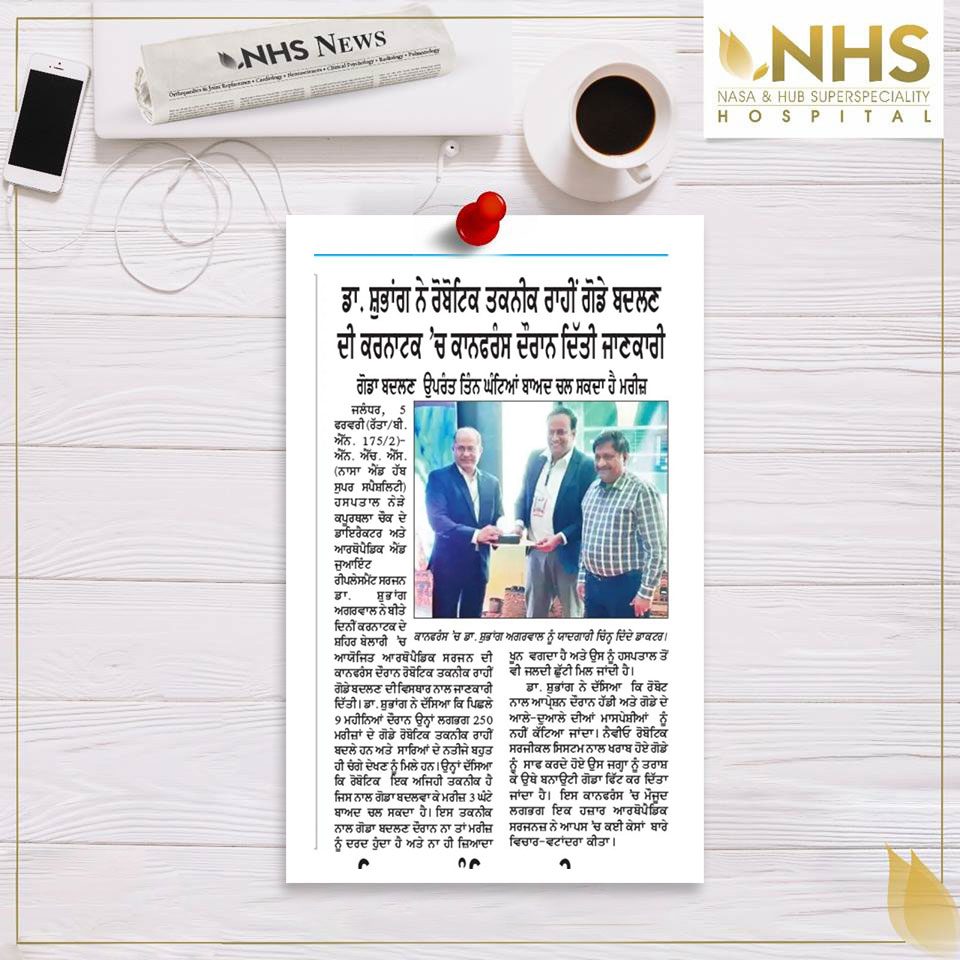
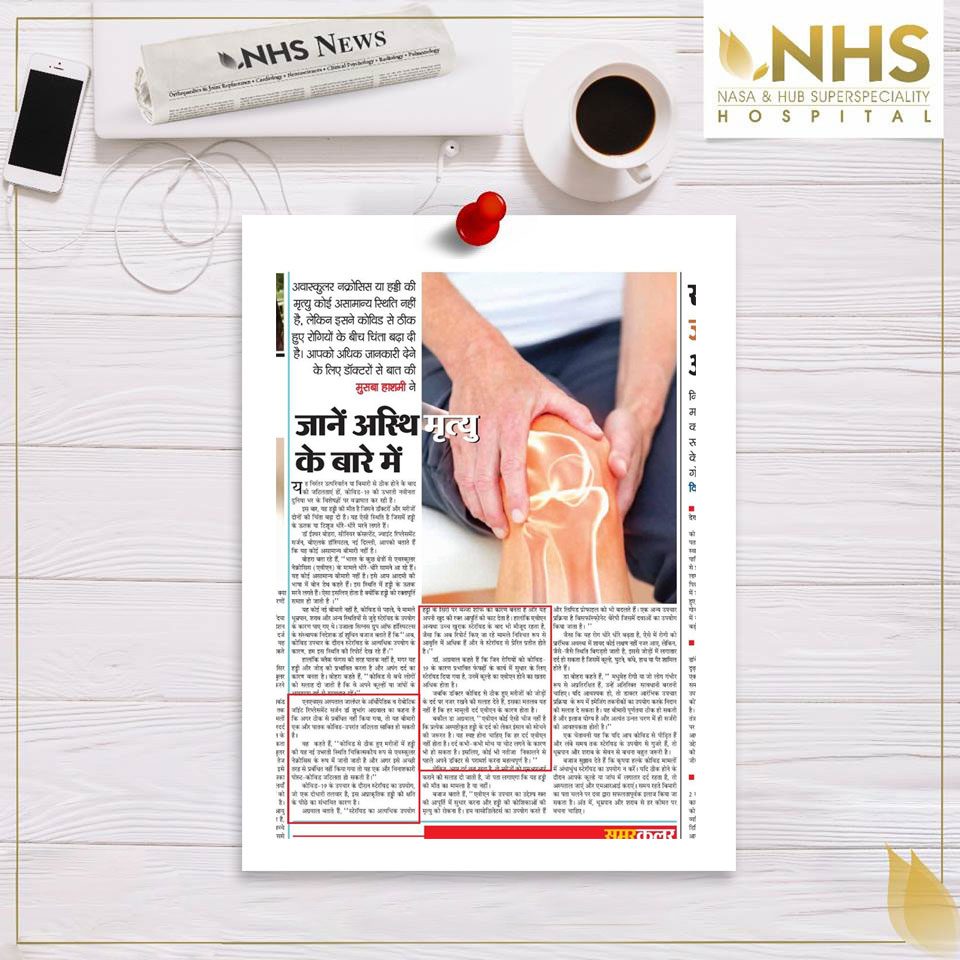
When robotics arrived in Jalandhar it made the front pages, and the orthopaedic team has been quoted on knees, hips, backs and sports injuries ever since. Open any clipping to read it at full size.
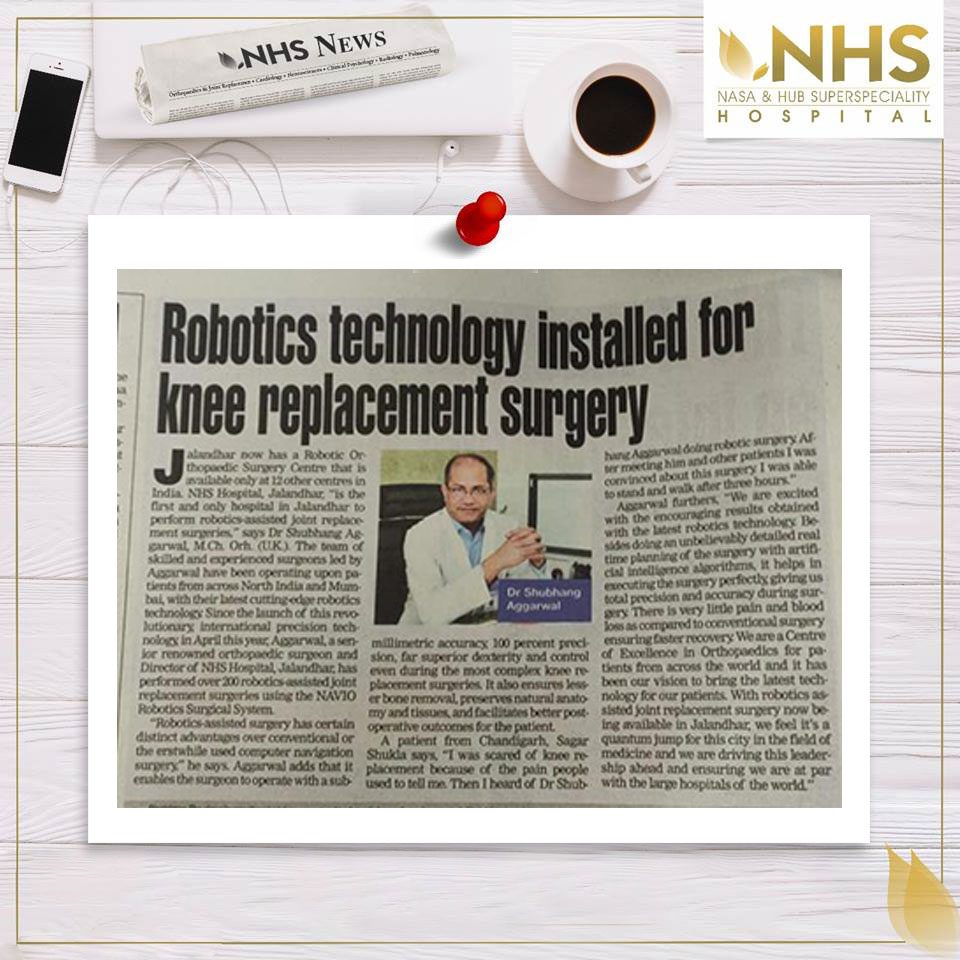
"Robotics technology installed for knee replacement surgery"
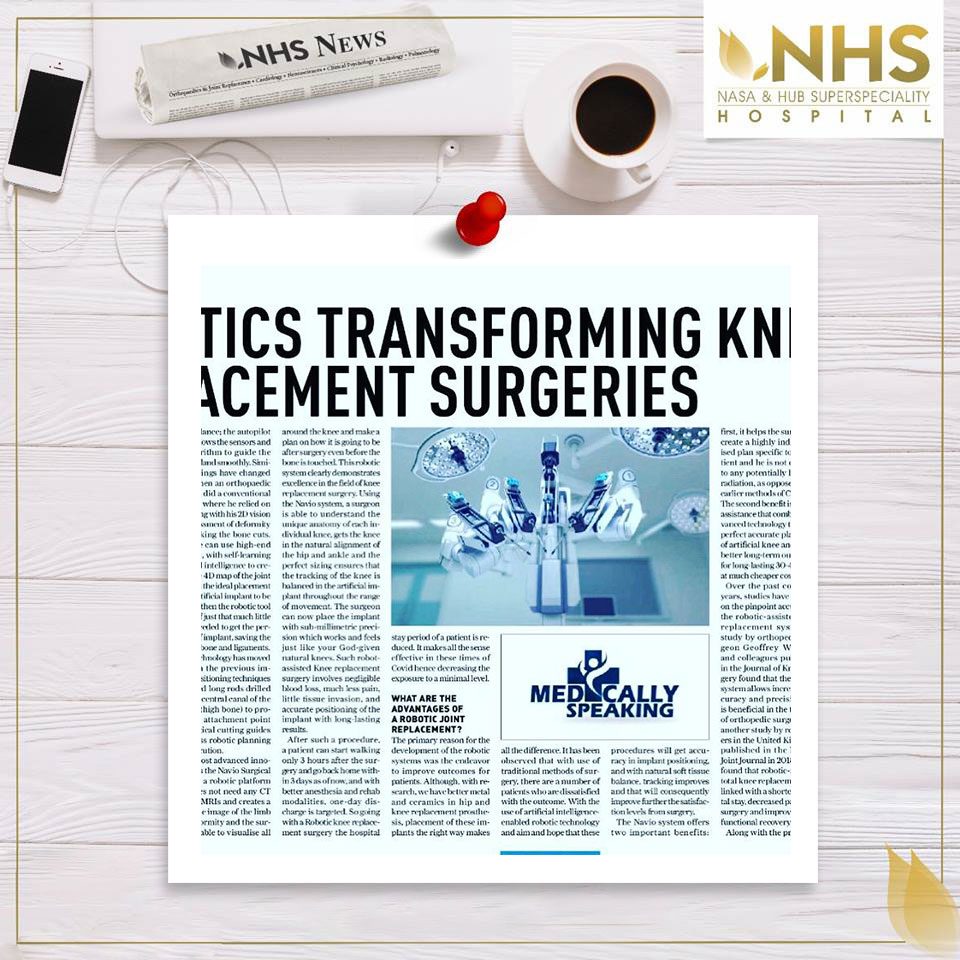
"Robotics transforming knee replacement surgeries"
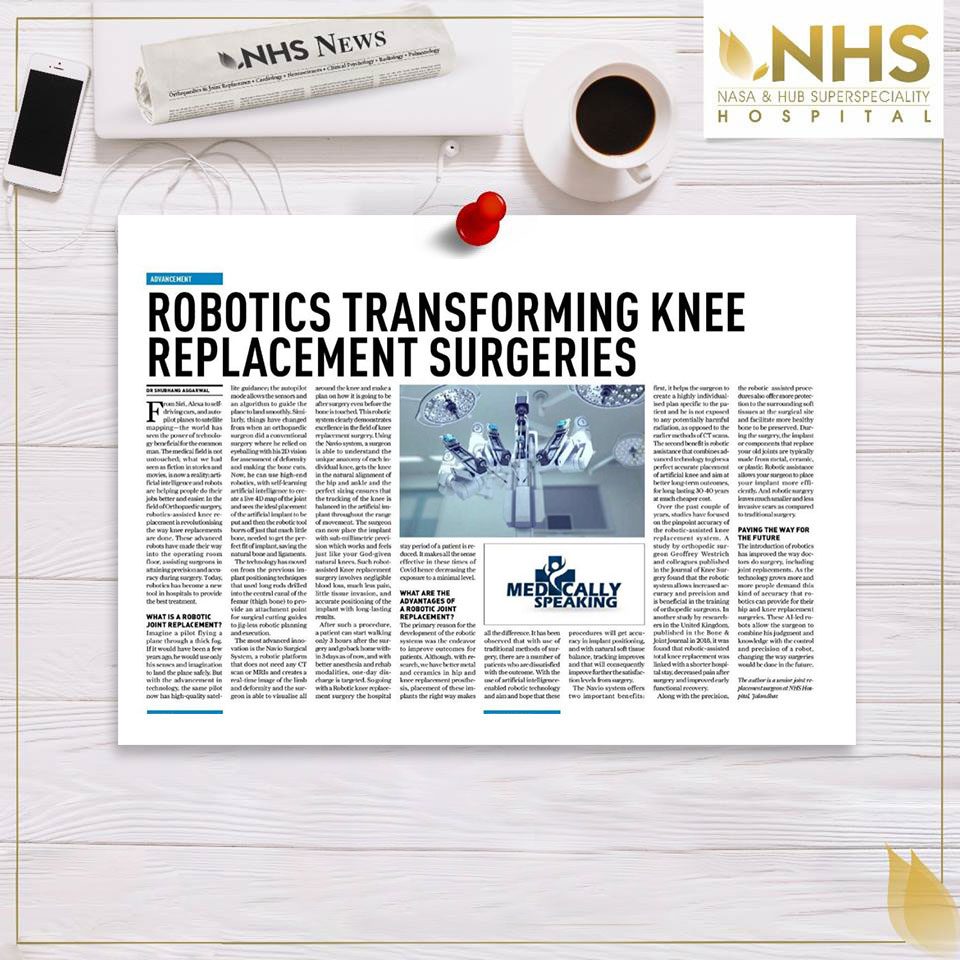
"Robotics transforming knee replacement surgeries" — the full page
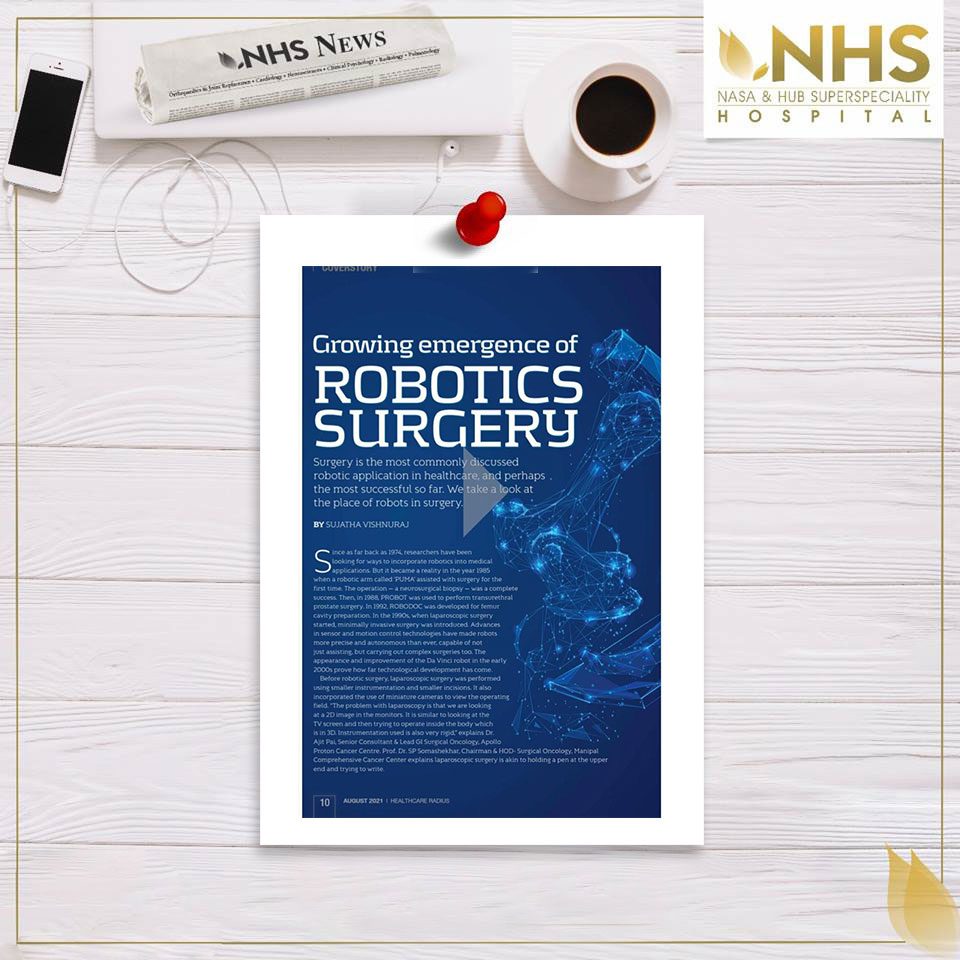
"Growing emergence of Robotics Surgery"
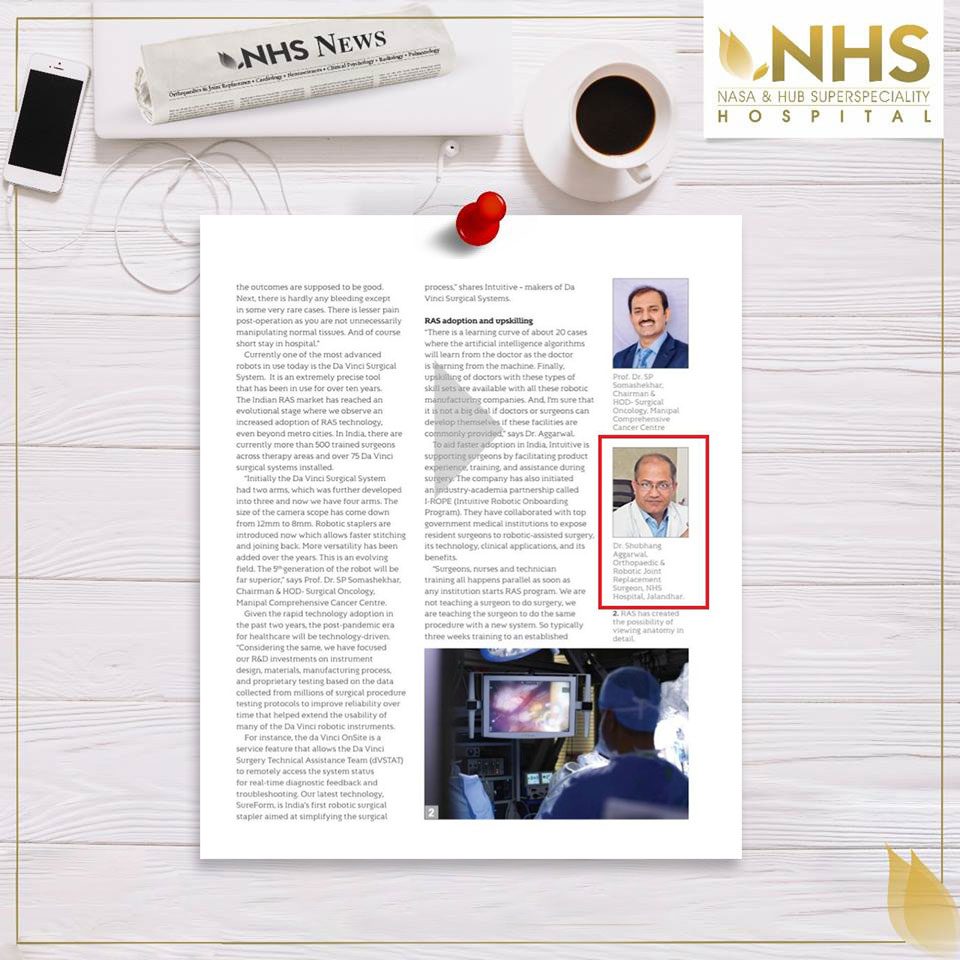
Feature on robot-assisted joint surgery
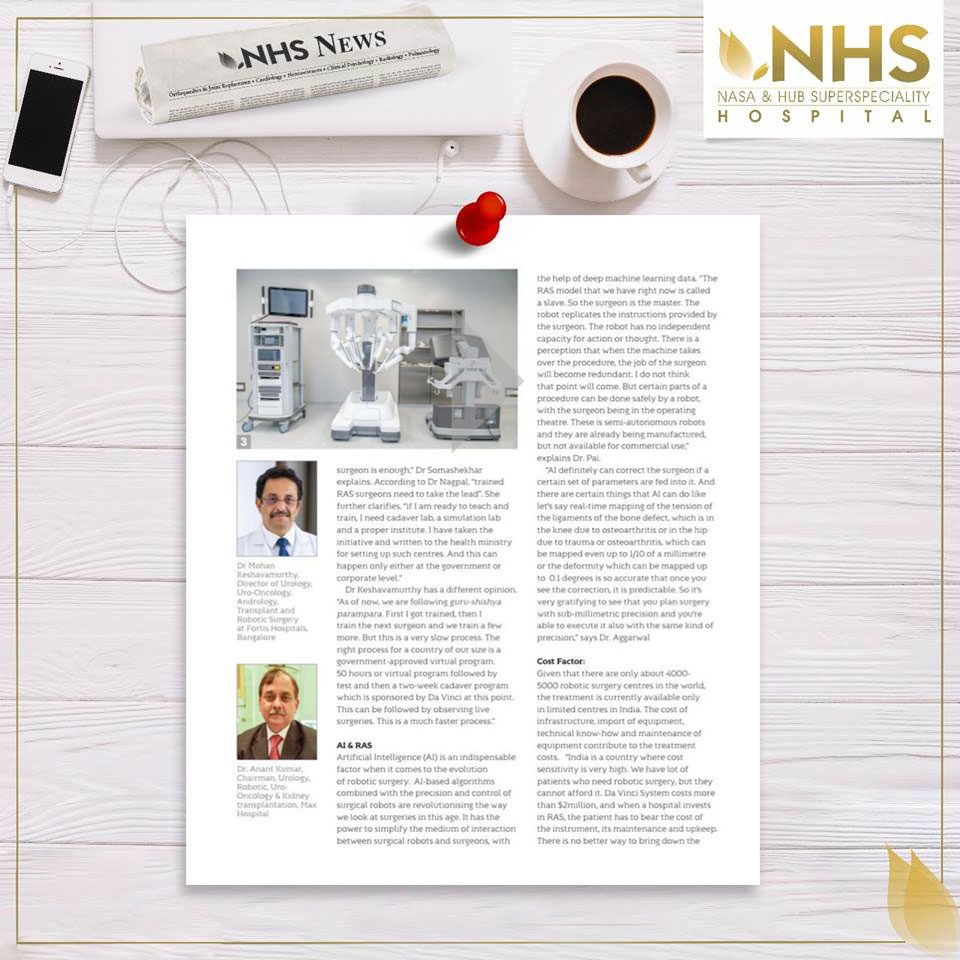
Feature on joint replacement imaging and planning
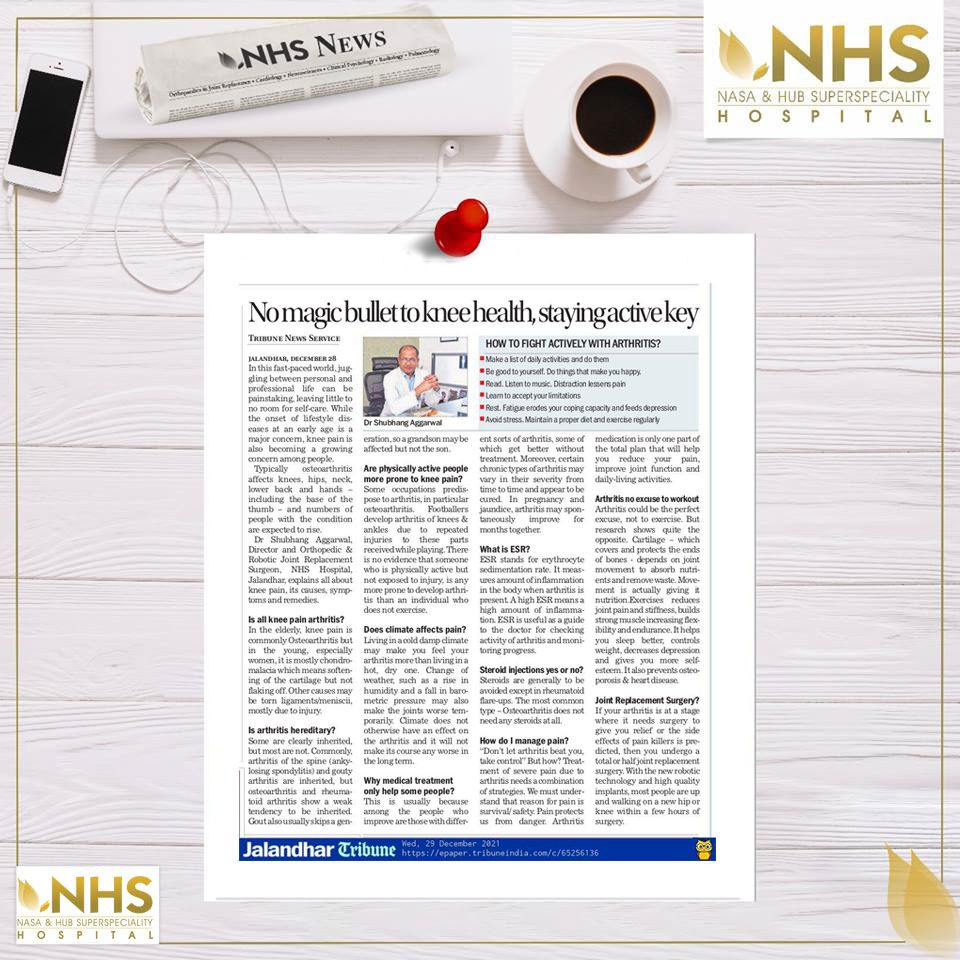
"No magic bullet to knee health, staying active is key" — Jalandhar Tribune
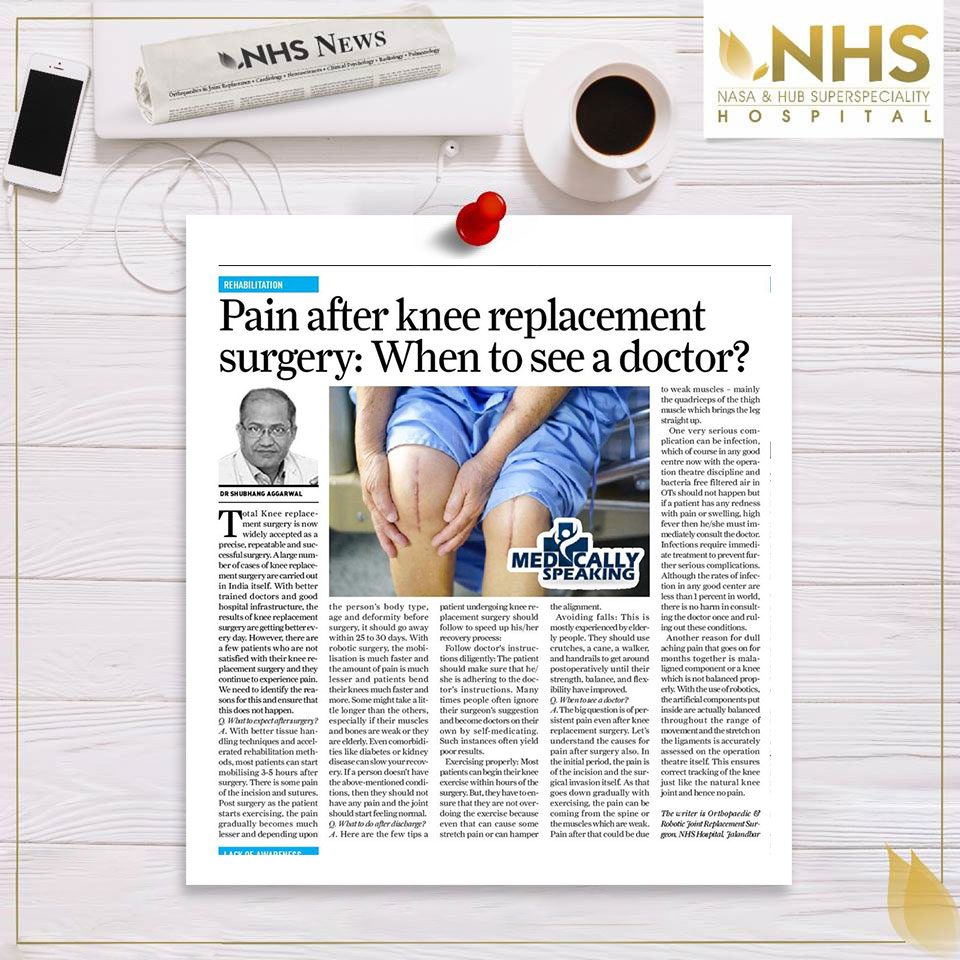
"Pain after knee replacement surgery: when to see a doctor?"
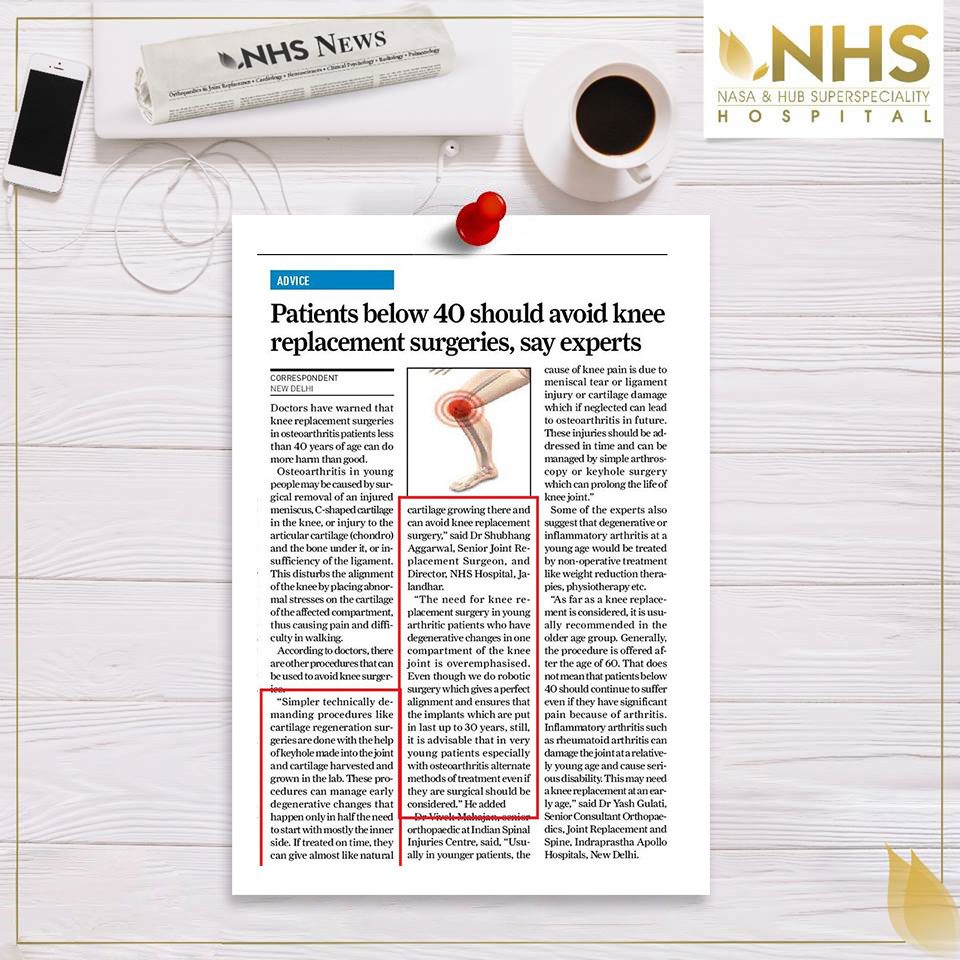
"Patients below 40 should avoid knee replacement surgeries, say experts"

"ACL tear: a common knee injury among sportspersons"

"Lower back pain: the 10 prominent causes for it"

"Restoring quality of life" — on joint replacement outcomes
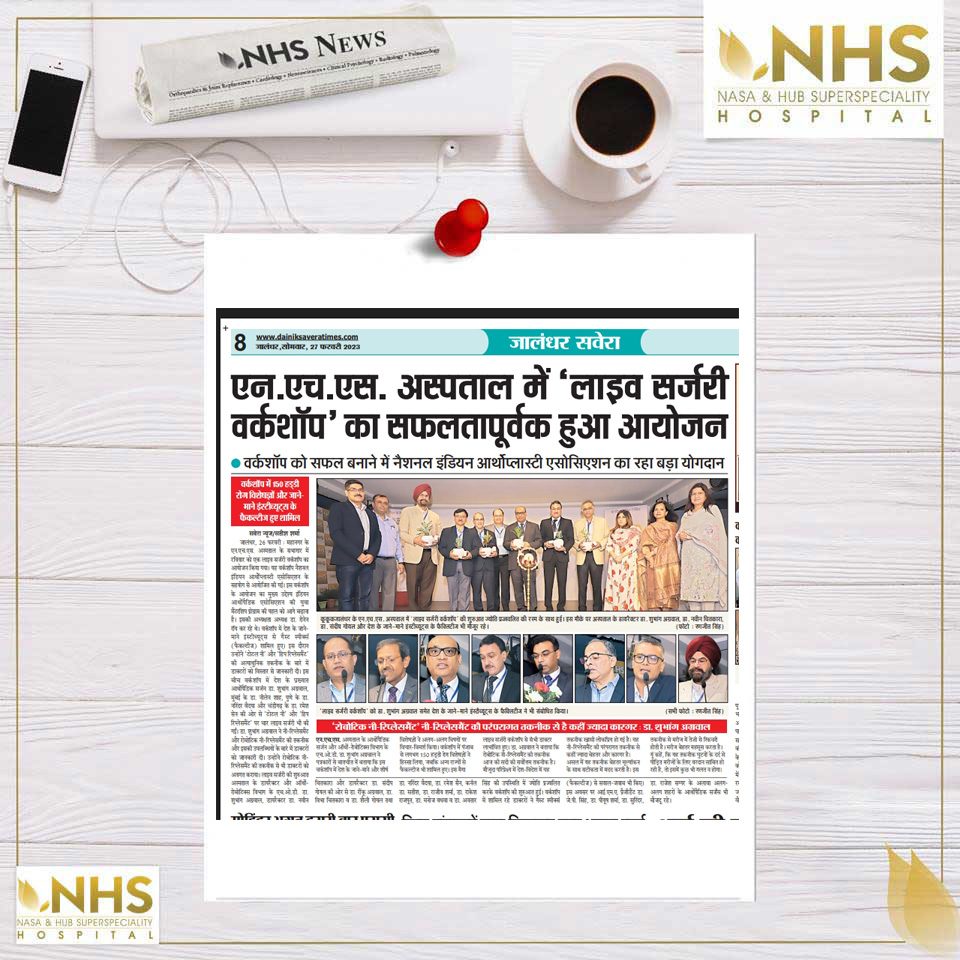
Live surgery workshop at NHS, attended by around 150 bone specialists
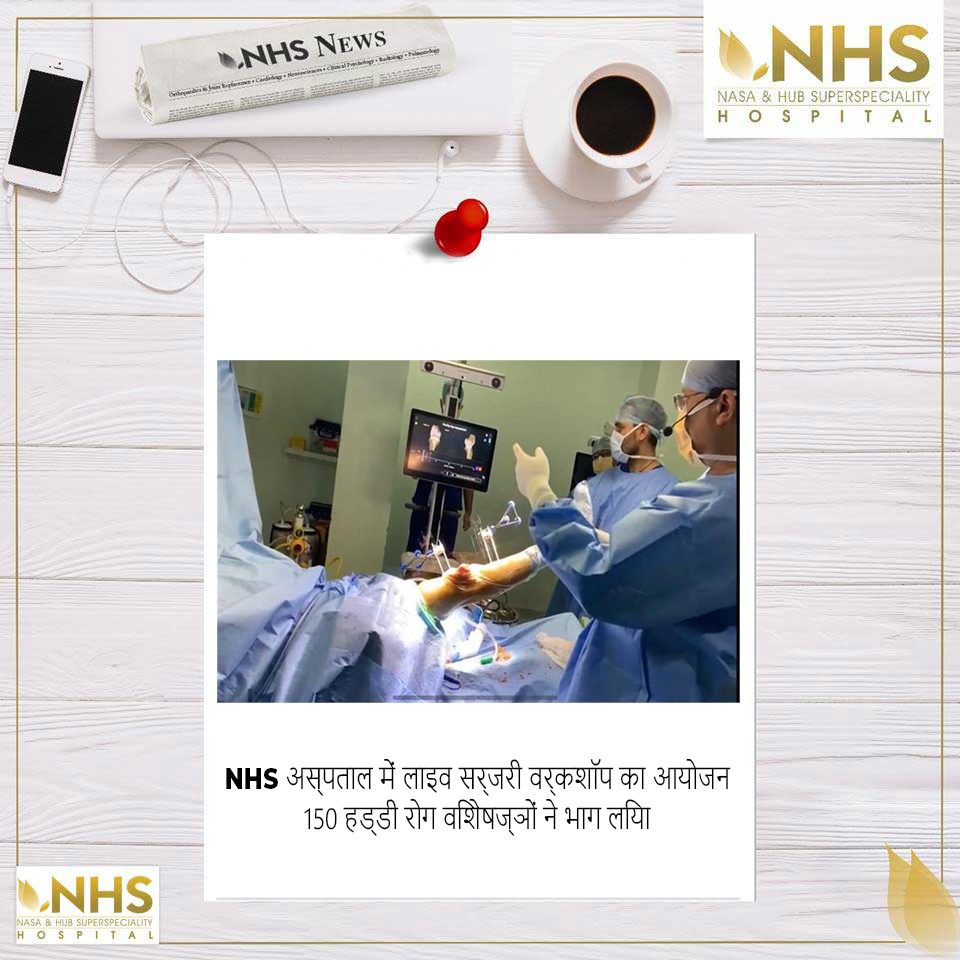
A second paper covers the same live surgery workshop
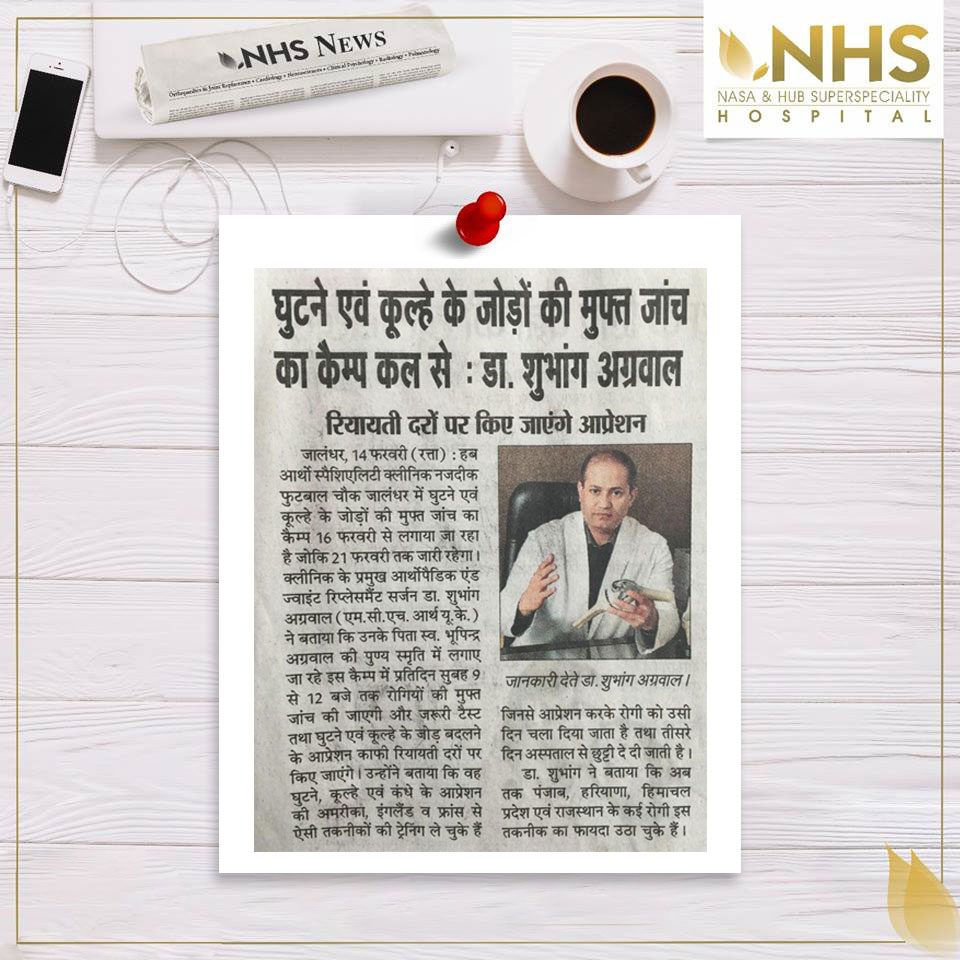
Free knee and hip screening camp announced by Dr. Shubhang Aggarwal
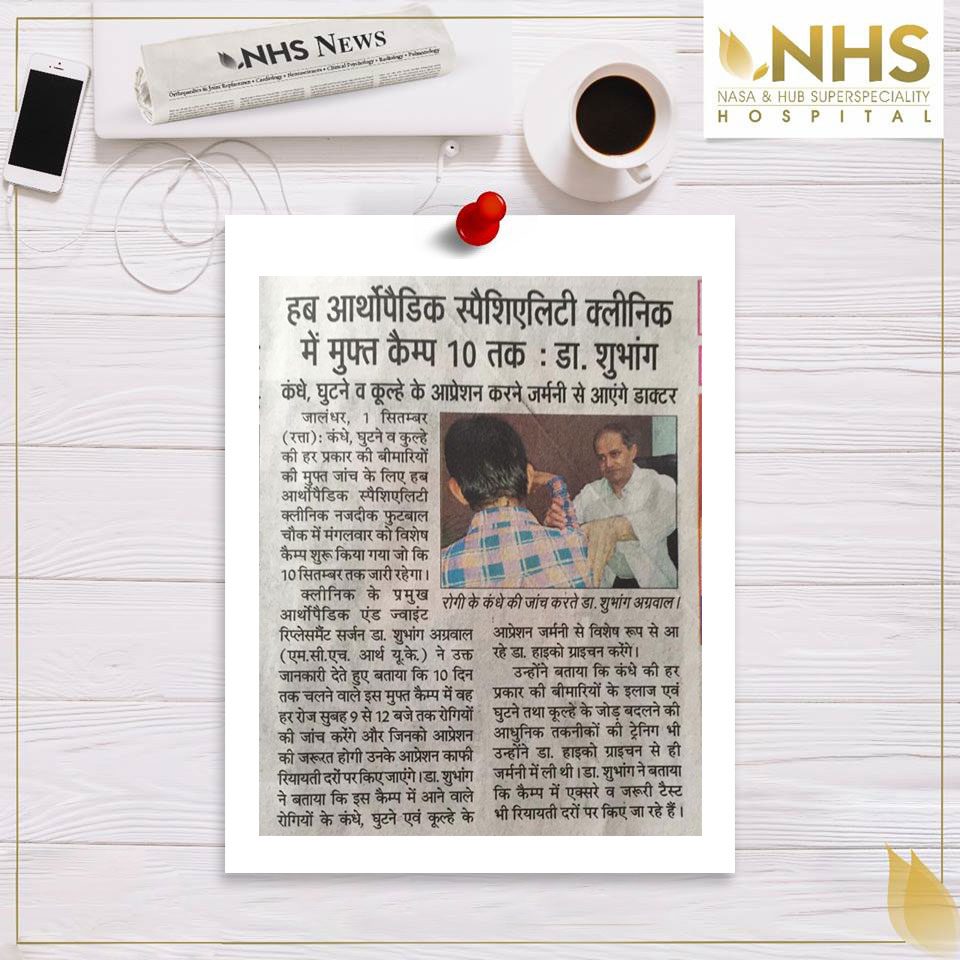
Another free knee and hip joint screening camp
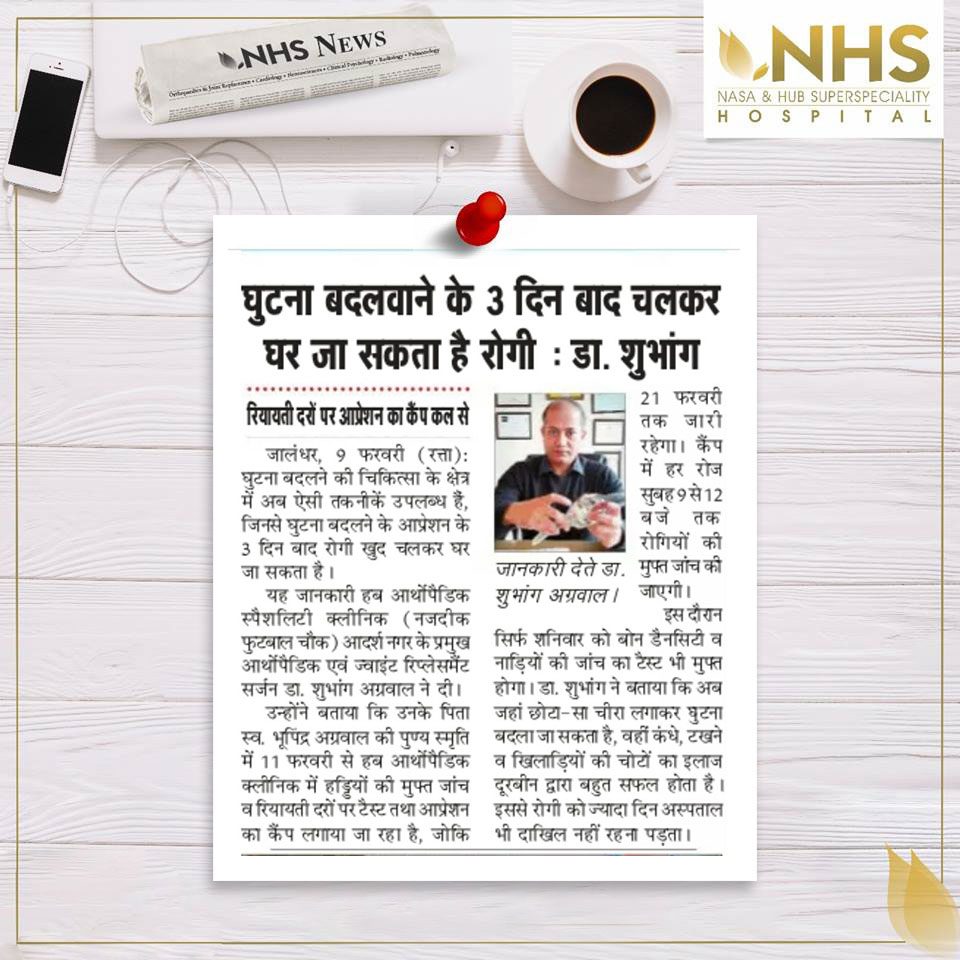
Patient walks home three days after a knee replacement
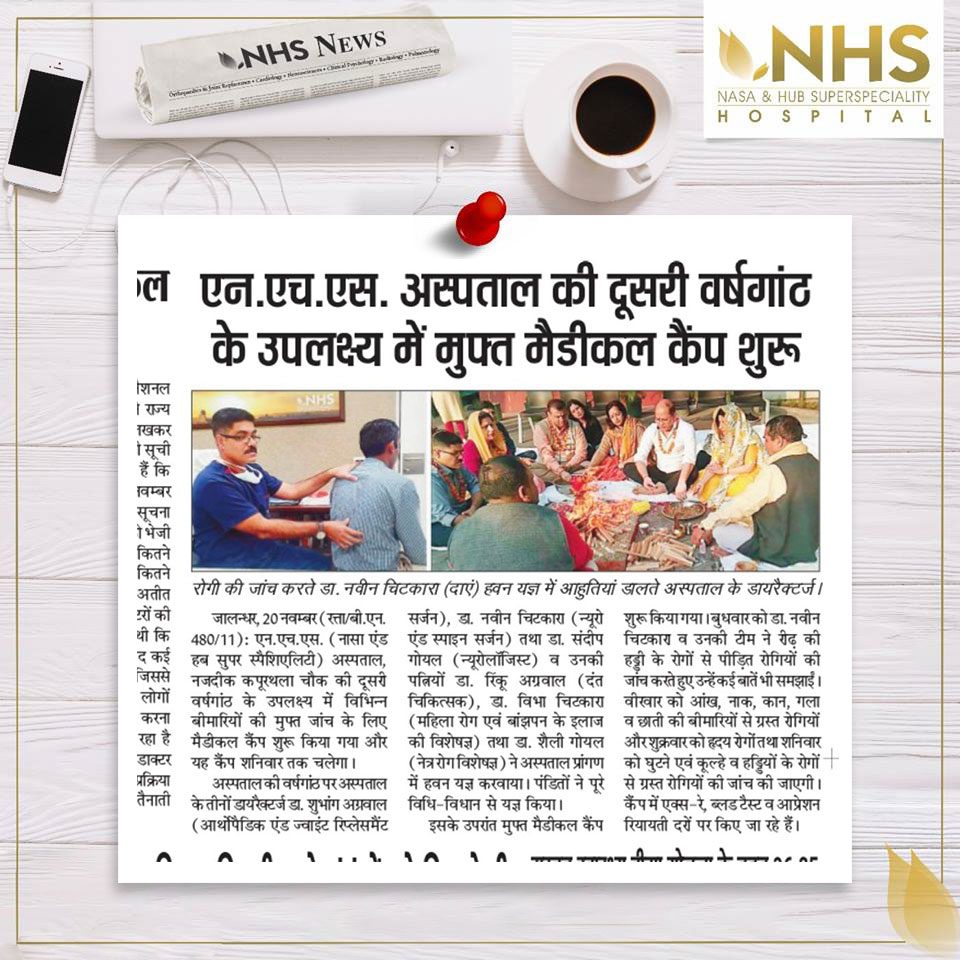
Free medical camp marking the hospital's second anniversary
A robotic arm assists the surgeon through the replacement so the bone work lands exactly where it was planned to land. The system first builds a 3D model of your joint from your imaging, then holds the surgeon inside that plan — which is what improves the result and shortens the time it takes you to get moving again.
No — it has no independent function at all. The orthopaedic surgeon operates it from the first step to the last, and what it contributes is a live map of the joint that keeps cuts inside sub-millimetre tolerance. Think of it as sharpening the surgeon's hand, never as substituting for it.
Set against the traditional method, the robot-assisted operation is more precise, goes in through a smaller incision, leaves you in less pain, gets you moving again sooner, and holds up better over the years that follow.
Walking generally begins within 24 hours of a robotic knee replacement. Getting the whole way back takes roughly 6 to 8 weeks of physiotherapy. Patients who have had a half knee here are frequently discharged the same day.
A half knee replacement — the unicompartmental operation — resurfaces the one worn compartment, medial or lateral, and leaves the healthy bone, cartilage and ligaments in place. A total replacement resurfaces the joint entirely. Which one you need turns on how much cartilage has gone, how much pain and swelling you have, and how far your daily function has narrowed. That is a judgement only your treating doctor can make.
A partial knee implant is built for 15 to 20 years and frequently outlasts that; a full replacement, looked after properly, generally runs 25 to 30 years or more. What decides the number is how accurately it was put in, what it is made of, what you weigh, how hard you use it, and how seriously you take your rehabilitation.
Age on its own decides nothing. We go on your pain, the X-ray grade, how far you can walk and how fit you are generally — in short, how badly the joint is damaged and how much that damage is costing your daily life. A good number of patients are managed without any operation at all.
Nearly everyone gets their movement back — stairs, a bicycle and a normal day's walking are all realistic again. Build swimming, cycling and walking into the week, because the muscles around the implant carry a good share of the load. Running and jumping are the things to leave out: repeated pounding wears the bearing surface faster than anything else. Past that it comes down to weight, diet, and actually turning up for physiotherapy and follow-ups.
Typically a short inpatient stay with walking started early, followed by a structured physiotherapy plan continued at home. You go home with a discharge folder covering medicines, wound care, diet and scheduled follow-up dates.
You are counselled before admission and your diagnostic checks are completed. Your medical history is handed over, a room is allotted to you, and one of the senior consultants then examines you clinically before theatre.
We explain both options honestly, with costs, and recommend robotics where the accuracy genuinely changes your result.
Send reports on WhatsApp first. We schedule consultation, tests and surgery close together so one trip is usually enough. If you want a formal review before travelling, the Second Opinion Clinic normally returns an evaluation within 24 to 48 hours.
Yes. A dedicated cashless and panel helpdesk deals with the major TPAs, public insurers and corporate health schemes. Hand your policy card and photo ID to the cashless desk when you are admitted; the TPA usually clears the file within two to four hours.
Yes. Paediatric orthopaedics and scoliosis run as separate services inside the department, covering flat feet, bow legs and knock knees, growth plate injuries, developmental dysplasia of the hip, spinal curvature and playground injuries. Book a slot if joint pain or swelling is not settling, if there is a limp, if one leg looks shorter or more bowed than the other, if bending or stairs have become hard work, or if walking milestones are being missed.
Talk to our coordinator today. Near Sports College, 300m from Kapurthala Chowk, Jalandhar — 144001.